A Public History Project
wELc0m3 hOm£ ¿ is a series of paintings that explores memory through the spaces that shaped my childhood as a working-class South Asian kid growing up in Toronto. Depicting the façades of spaces my family frequented in the early 2000s, the exhibition shifts attention from memories of people to memories of place. Each building becomes a vessel for personal and collective histories, revealing how belonging is formed through everyday encounters with the city.
Surrounded by archival photographs, advertisements, newspaper clippings, and public records, each painting traces the social and political histories embedded within these sites while considering how redevelopment, rising costs, and urban planning reshape not only Toronto’s landscape, but also the memories and communities attached to it. Together, these paintings ask what it means to feel at home in a city that is constantly changing, and what is lost when the places that hold our stories disappear.
Where is home? – Google My Maps
This map traces the locations in Toronto that feel like home to me, and that became subjects of wELc0m3 hOm£ ¿. Each location connects to one of the paintings in the exhibition, bringing together personal memory, historical research, and the stories of places that have changed, disappeared, or remained.
Click through the map to explore each painting and the memory behind it, alongside the history of the place and the communities connected to it.
This map asks how our personal memories become part of a city’s larger history, and what happens when the places that hold those memories change.
Where do we find home?
And what makes a place worth remembering?
Where is home? – Exhibition Map
Toronto is made up of thousands of different homes. some are houses. some are neighbourhoods. some are places we visit, communities we belong to, or spaces that no longer exist.
Visitors are asked to place a pin somewhere in toronto that feels like home & Fill out the google forum.
**These spaces will be used to continue the project**
Artworks in order of appearance at She said gallery
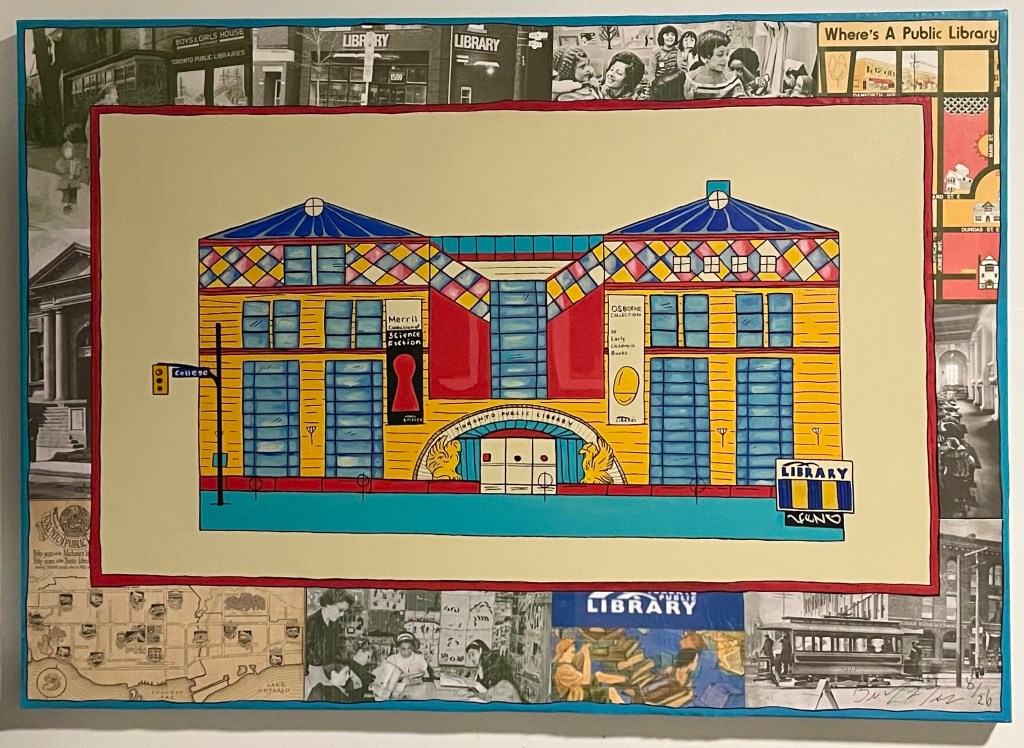
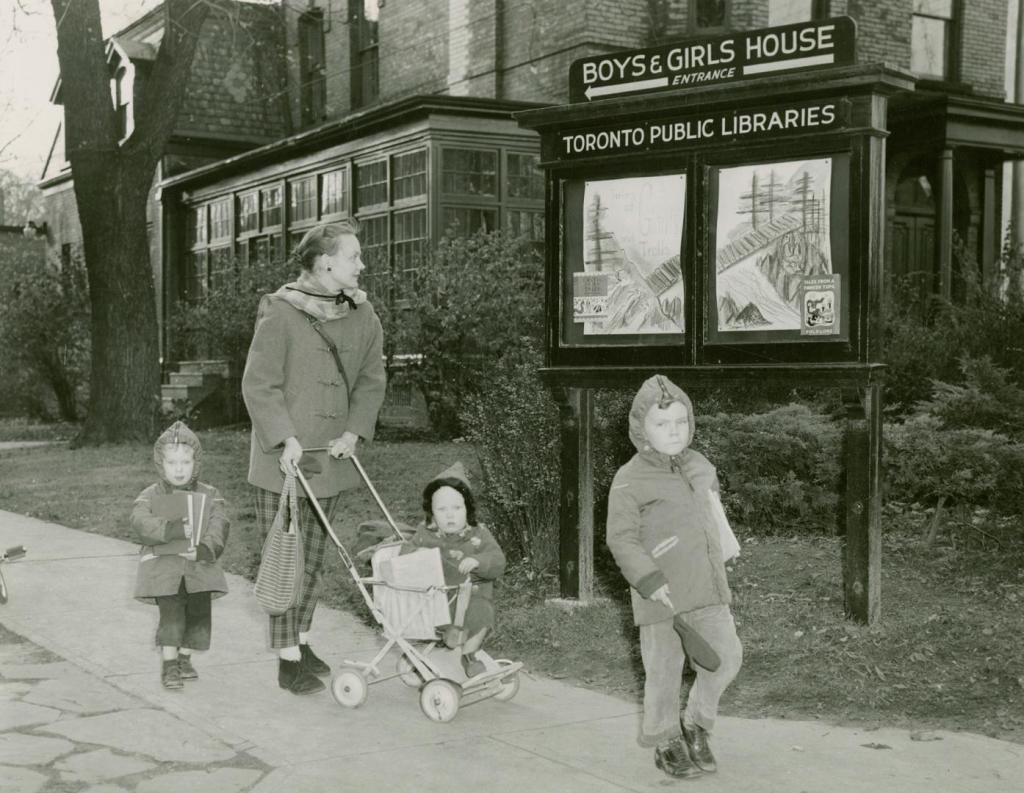
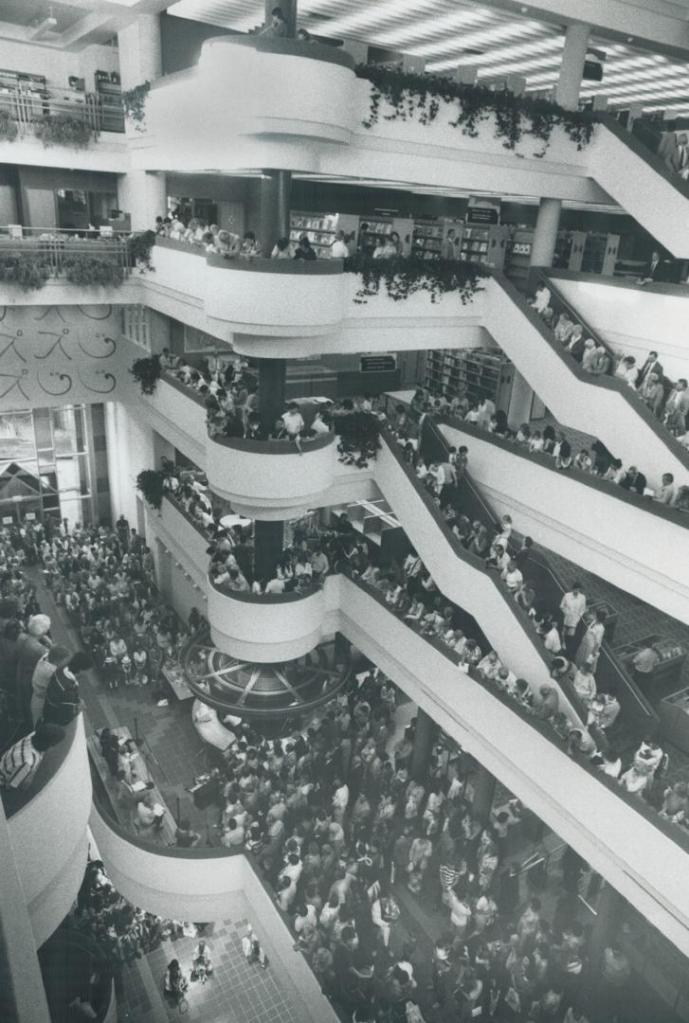
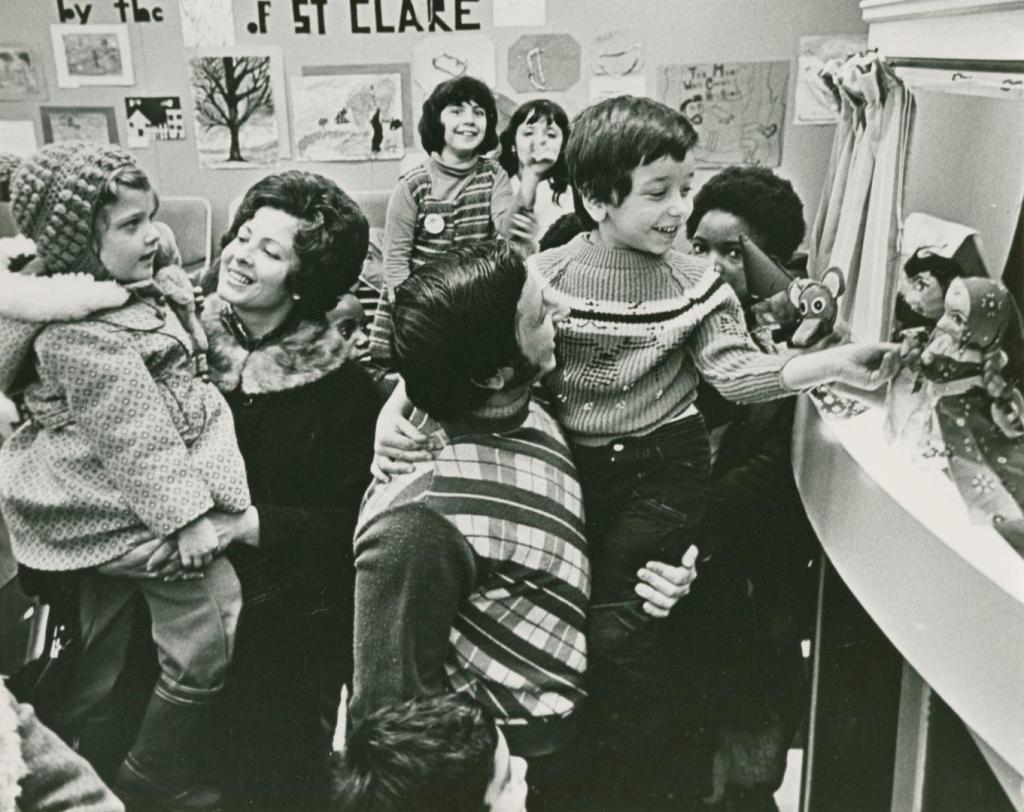
I Never Liked Carrot Muffins
24 x 34″
Mixed Media on Canvas
August 2026
MEMORY
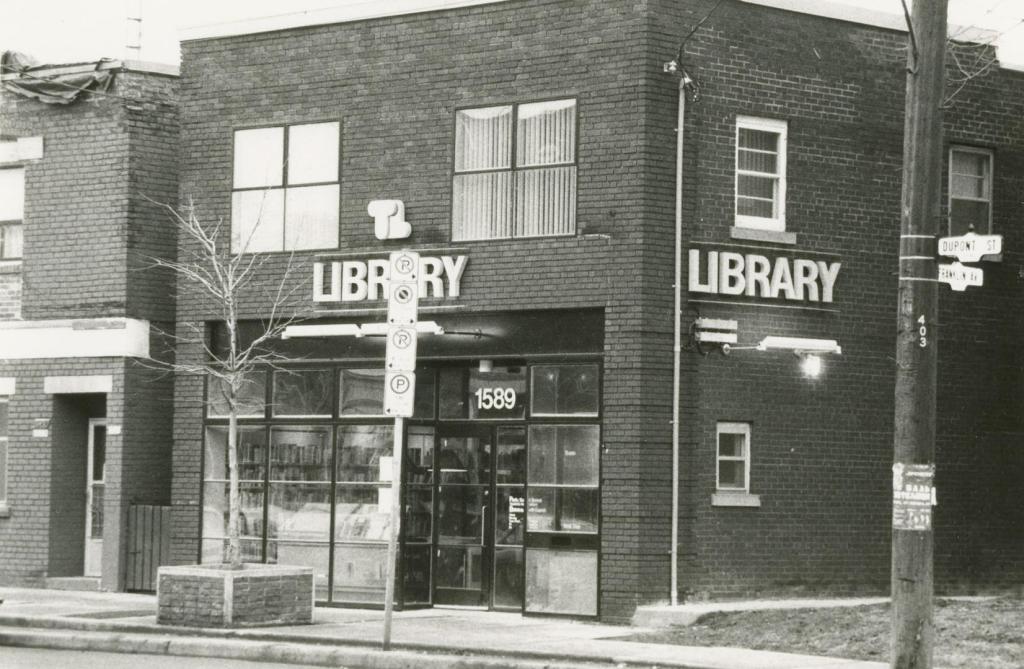
My mom used to wake up at 4 am on Saturdays so she could stand in line at the library for MAP passes. I don’t remember those early mornings, but I remember my dad waking us up at 7:30 am and driving us to the library, where we would meet my mom and wait together until it opened. Once she got the passes, we would spend a little time playing at the library before heading out. Afterwards, my mom would take us to the nearby McDonald’s and buy a carrot muffin for us to split between the four of us. I remember visiting the Art Gallery of Ontario, the Royal Ontario Museum, and the Bata Shoe Museum plenty of times. I remember the Gardiner Museum, the Ontario Science Centre, and the Toronto Zoo. We also went to Casa Loma, although I don’t actually remember that one. I fell in love with dinosaurs, space, and the shiny purple rocks at the ROM. I’m grateful to my mom for waking up so early so we could grow up exploring these spaces, and to the Toronto Public Library for making those experiences possible.
HISTORY
By 1882, the Toronto Mechanics’ Institute library held 27,000 books but lacked sufficient funding from membership fees. John Hallam proposed establishing a new institution supported by municipal taxes, made possible by the Ontario Free Libraries Act of 1882, modelled on British legislation and the first act of its kind in Canada. On March 6, 1884, the first Central Library opened in the former Mechanics’ Institute building at Church and Adelaide streets. Two additional branches opened that February in rented spaces at St. Paul’s Hall on Yonge Street and St. Andrew’s Market at Richmond and Brant streets. The library soon expanded its services by acquiring non-Canadian books in multiple languages, beginning with French and German in 1885, Italian in 1888, and Spanish in 1894. Services for people with disabilities began in 1895 with the purchase of 70 Braille books. As the Mechanics’ Institute collection grew, the Central Reference Library opened at College and St. George streets in 1906, in what is now the Koffler Student Centre. The city used the Mechanics’ Institute building for nearly two decades before demolishing it in 1950. By the 2000s, the Toronto Public Library had developed into the largest public library system in North America, expanding digital access, branch hours, and community programs. Efforts to promote equitable access included increasing Sunday service from 28 to 37 weeks annually and extending it to selected neighbourhood branches based on geographic equity and community needs. The Museum and Arts Pass (MAP) was established in 2007 with funding from Sun Life Financial, providing low-income families with free admission to museums and art galleries. By 2017, an estimated 1.5 million people had participated. After a hiatus in 2020, the Bennett Family Foundation helped the program continue and expand.
SOurced material
“History of Toronto Public Library,” Toronto Public Library, 2024, https://tpl.ca/about-the-library/library-history/
Macrae, Emily. “A History of the Toronto Public Library in Four Buildings,” Active History, September 2, 2020, https://activehistory.ca/blog/2020/09/02/a-history-of-the-toronto-public-library-in-four-buildings/
Boys and Girls House, Toronto Public Library, 1958, Toronto Public Library Archives,
https://digitalarchive.tpl.ca/objects/375624/boys-and-girls-house-toronto-public-library/
A room in the Boys and Girls House of the Toronto Public Library, 1930, Toronto Public Library Archives, https://digitalarchive.tpl.ca/objects/375628/a-room-in-the-boys-and-girls-house-of-the-toronto-public-lib
Stairway to knowledge, 1987, Toronto Public Library Archives, https://digitalarchive.tpl.ca/objects/226892/stairway-to-knowledge
Toronto Public Library, Dufferin/St. Clair Branch, 1973, Toronto Public Library Archives,
https://digitalarchive.tpl.ca/objects/335448/toronto-public-library-dufferinst-clair-branch-dufferin
Perth/Dupont Branch, 1983, Toronto Public Library Archives,
https://digitalarchive.tpl.ca/objects/388459/perthdupont-branch
The 19 Bay Bus
30 x 36″
Mixed Media on Canvas
July 2026
MEMORY
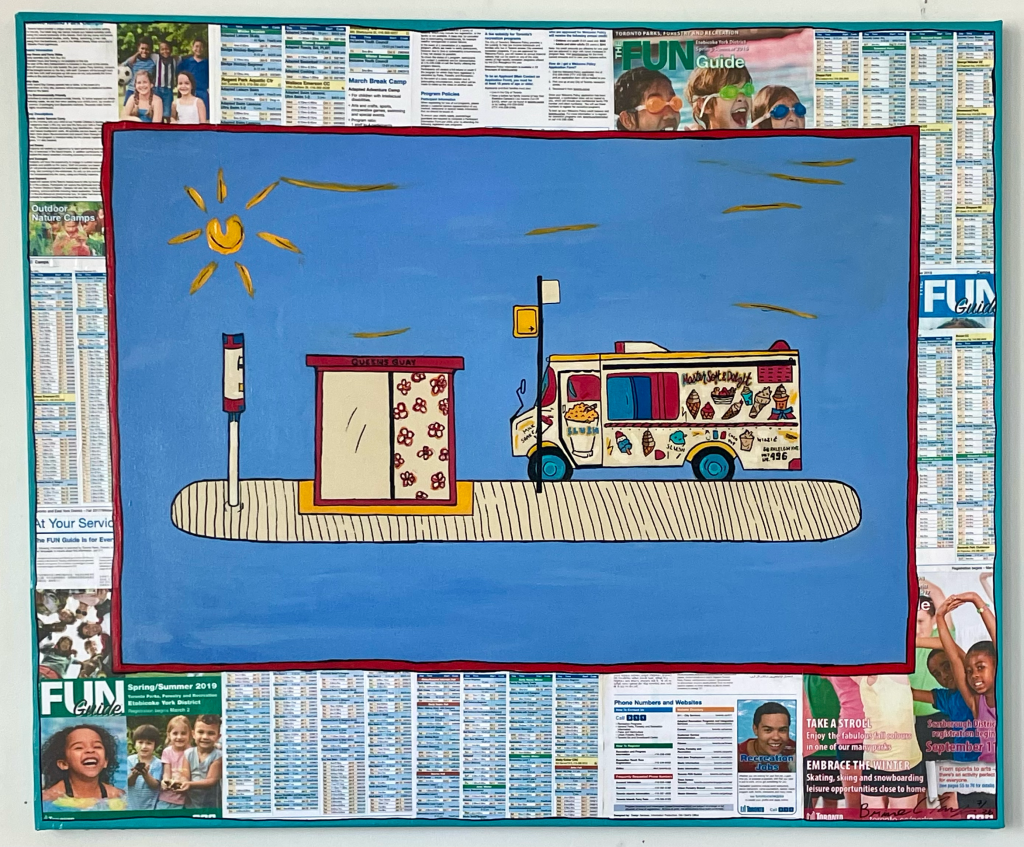
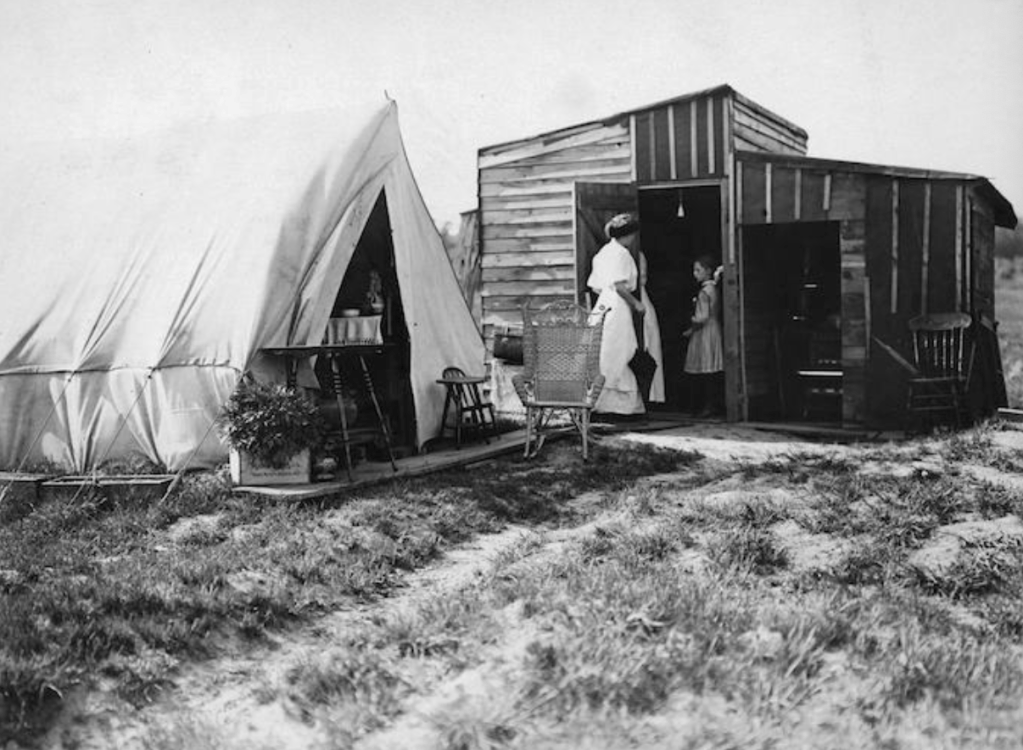
My mom enrolled us in whatever Toronto Summer Camps were covered through the Welcome Policy. My favourite were the overnight camps, but every year we spent four weeks at Centre Island. Usually, it was boating camp, although one year it was fishing camp. Eventually my mom started working, which meant she could no longer pick us up from camp. Instead, she taught us how to take the 19 Bay bus home at exactly 3 pm. After camp, my big sister and I would wait at the bus stop and share a $1.50 ice cream twist from the ice cream truck next to the stop. I was a big saver with my allowance, but I was willing to indulge in ice cream. I remember when my little sister attended the same camp a few weeks later. I bought a banana split for the three of us to share. It looked much better in the advertisement than it actually tasted. The funny part is that if you go back far enough on Google Maps, it’s the same ice cream truck sitting there today. The only difference? That $1.50 ice cream twist now costs $5.
HISTORY
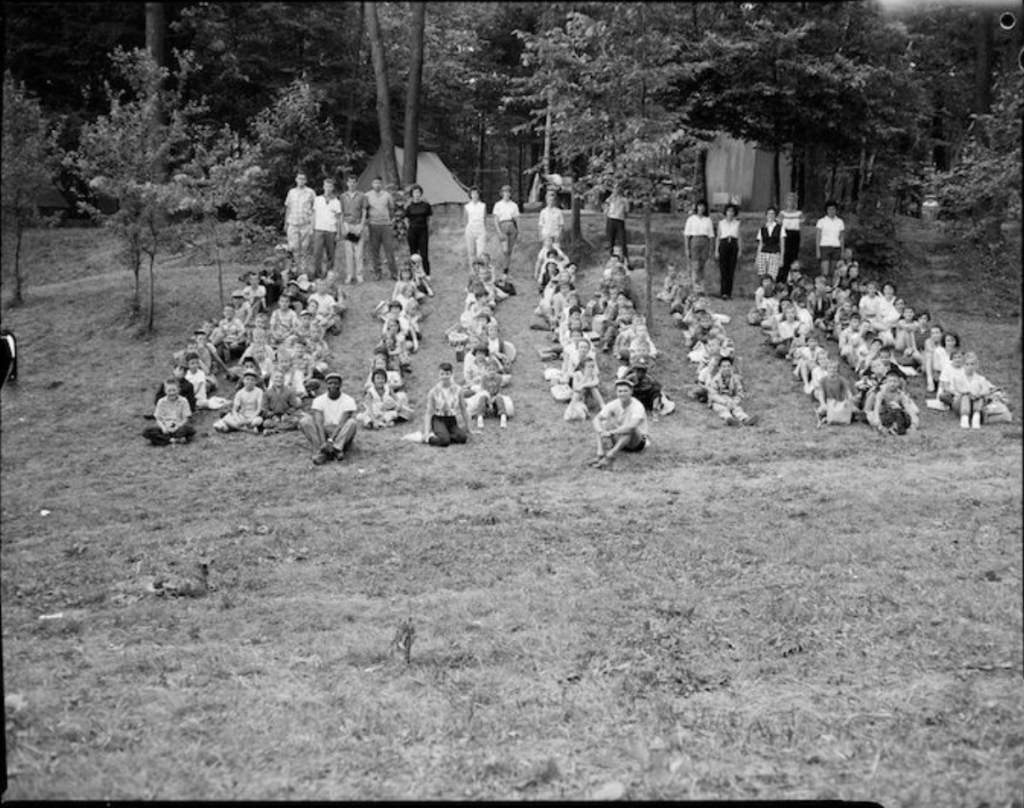
Summer camps in Toronto have a long history of providing children with recreation and access to community resources. In 1903, Toronto introduced its first supervised recreation programs, using school grounds during the summer before permanent community centres existed. In 1911, citizens formed “The City Playground” group under civic leaders, creating some of Toronto’s earliest structured neighbourhood programming and outdoor summer games.
In 1956, Bert Fine established Bathurst Manor Day Camp, described as the first children’s day camp in Canada, in the Don Valley. It was later renamed Forest Valley Day Camp and became Canada’s largest camp, serving more than 900 campers. Located at 50 Blue Forest Drive, the site was surrounded by more than 100 acres of forest and developed alongside the Bathurst Manor subdivision. Fine later approached the North York Board of Education about using the site year-round for student visits.
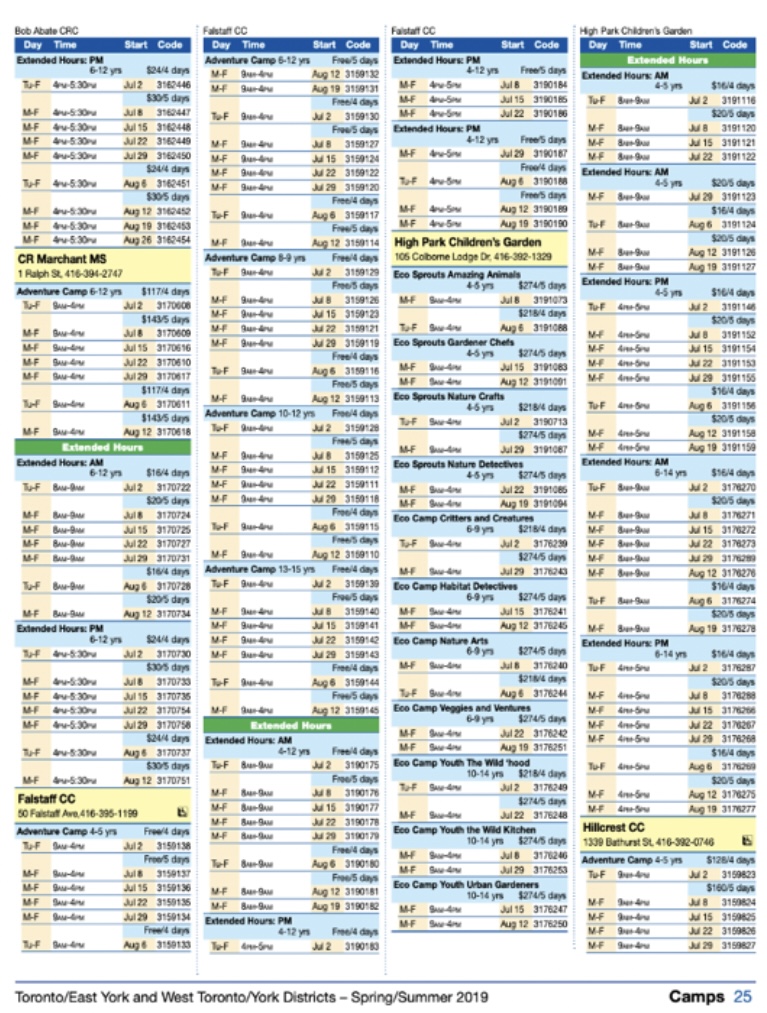
After the 1998 amalgamation of Toronto’s six former municipalities, the city unified its community centres and introduced the FUN Guide and online eFUN registration system. In the following year, Toronto established the Welcome Policy to make recreation more accessible to low-income residents. As dual-income households became more common, affordable municipal camps also became an important summer child-care option, creating intense demand for subsidised spaces, resulting in the “7:00 AM March registration madness”.
In 2012, the Welcome Policy changed to an annual credit of $455 for children and youth and $212 for adults and seniors. A similar income-based model continues today. Food security has also become an important part of summer camps, with Feeding Our Future launching through Second Harvest in 2000, and in 2020 Toronto expanded CampTO Nutrition, providing free daily meals and snacks to children at high-priority centres.
Sourced material
Camp Wallace, 1960. City of Toronto Archives, Fonds 217, Series 248, Item 2
Tent and Shack at Toronto Island, 1908, City of Toronto Archives, Fonds 217, Series 269, Item 128
Spring/Summer 2020 The FUN Guide, City of Toronto, Internet Archives
Spring/Summer 2016 The FUN Guide, Etobicoke York District, Internet Archives
Spring/Summer 2019 The FUN Guide, Etobicoke York District, Internet Archives
Fall/Winter 2016/2017 The FUN Guide, Scarborough District, Internet Archives
Campbell, Megan. “How Day Camps Became Summertime Day Care”, Macleans, March 6, 2017, https://macleans.ca/society/how-day-camps-became-summertime-day-care/
Levy, Joel. “Vintage Ontario Photographs of Summer Camps and Camping” Toronto Guardian, August 9, 2018, https://torontoguardian.com/2018/08/vintage-ontario-summer-camps-camping/
“I Want to be an Astronaut when I Grow Up”
28 x 34″
Mixed Media on Canvas
August 2026
MEMORY
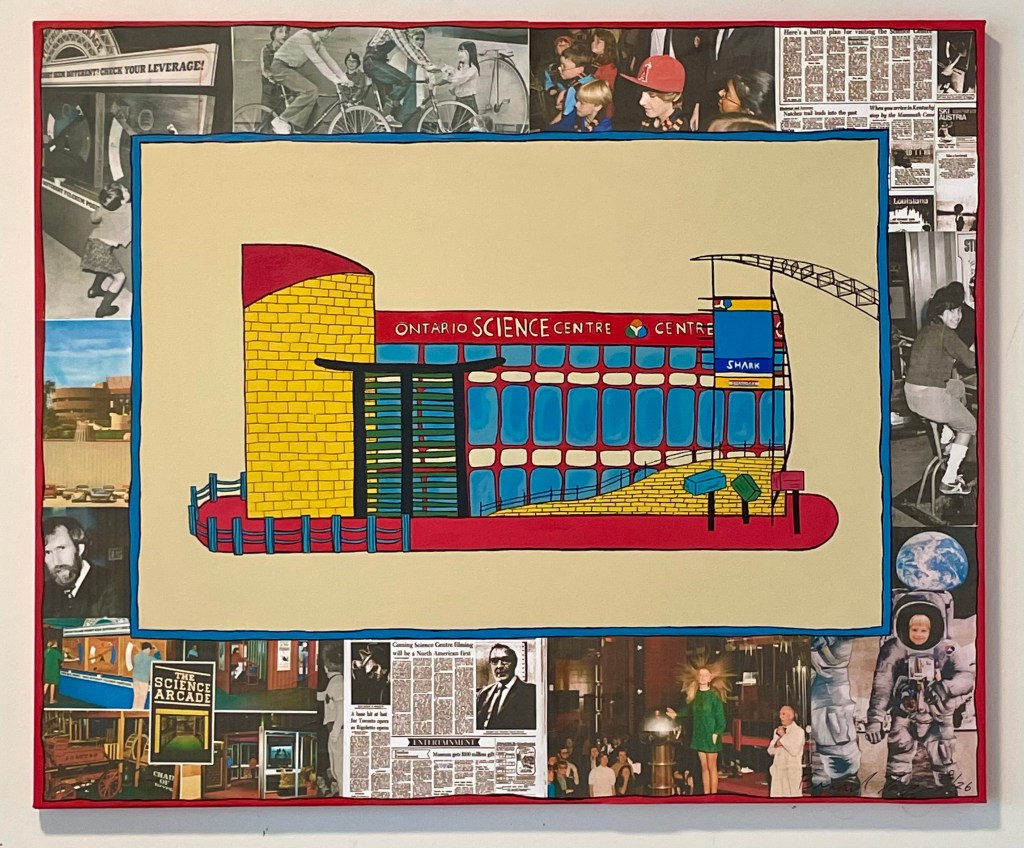
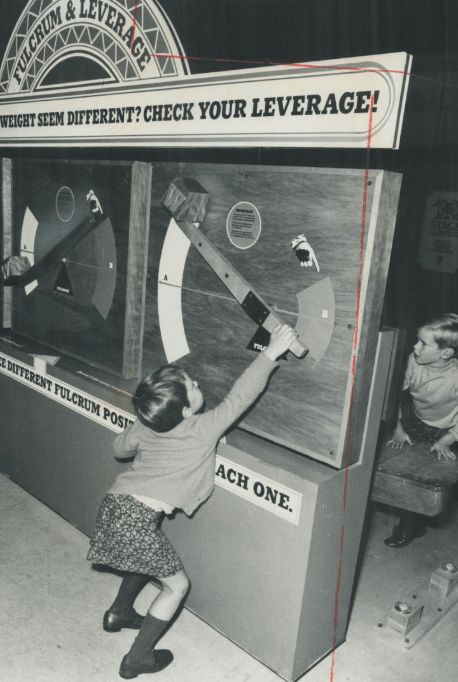
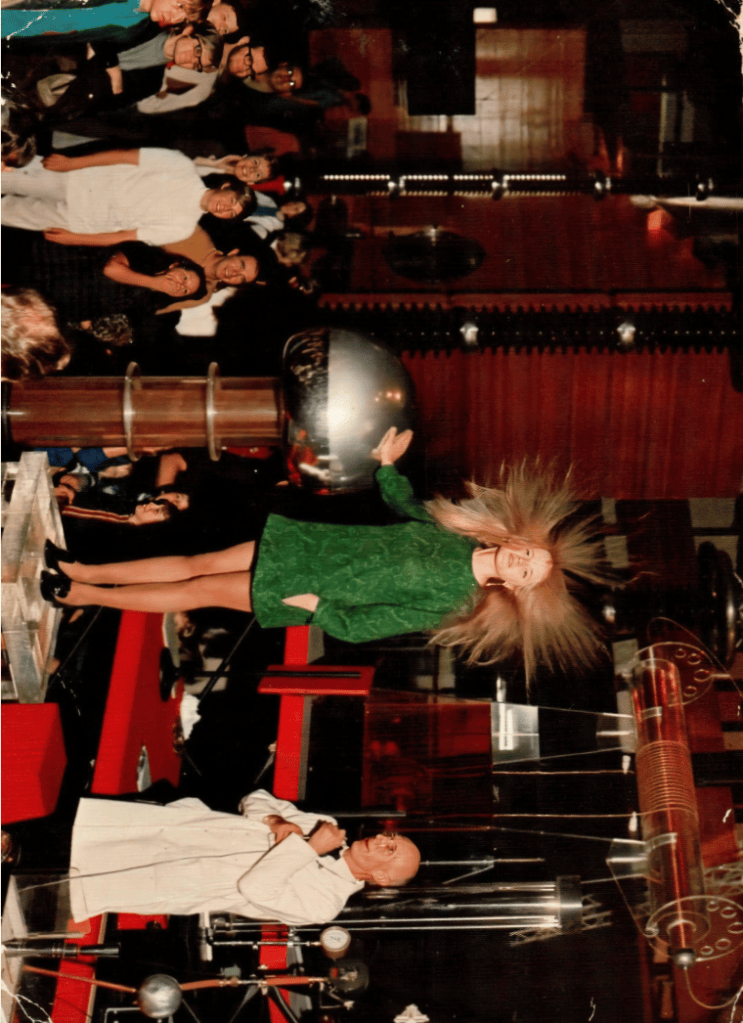
I wanted to be an astronaut after watching an IMAX film about space at the OMNIMAX theatre at the Ontario Science Centre. I wanted to be a marine biologist after watching one about the ocean. Every time I went, I left convinced I would grow up to be a scientist. When I was little, the Science Centre felt magical. I remember the crystals and fossils in the hallways, the rainforest and its leap frogs, and, honestly, my favourite place in the world was the grocery store in the kids’ area. When my sisters and I went with our mom, we split off into our own little worlds. I shopped for bell peppers and bags of sugar with a pretend credit card while Neha climbed ladders and built roofs out of styrofoam bricks. I can’t tell you when it changed. When did I stop seeing the world with a twinkle in my eye? When did I stop wanting to be an astronaut, planning to see every eclipse, and asking Santa for a telescope? I guess I grew up. But I still want to be an astronaut. I still want to be a marine biologist. Somewhere inside me, that little girl is still looking at the stars, believing she can become anything. Now I shop for bell peppers and bags of sugar at Food Basics, with a very real card with my name. And sometimes I wonder if growing up was ever supposed to mean giving up on what once seemed possible.
HISTORY
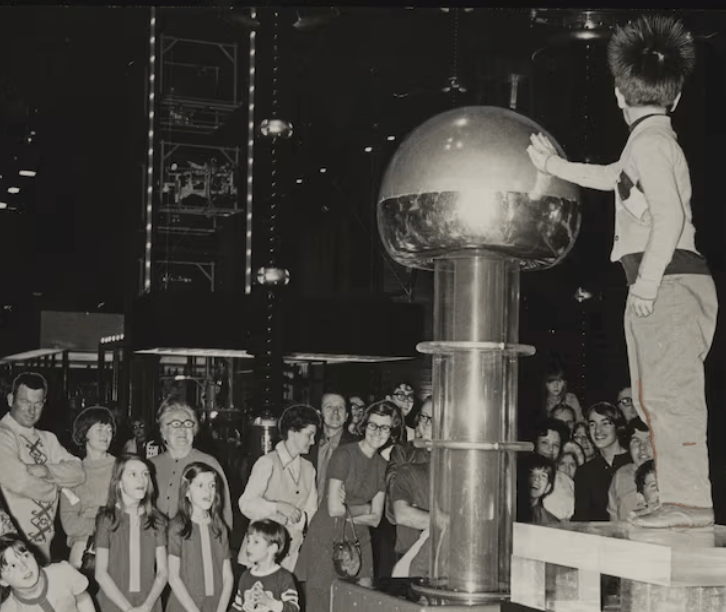
The Ontario Science Centre has long represented the importance of accessible public institutions within Toronto’s urban landscape. Opened in 1969 at 770 Don Mills Rd, the Science Centre was designed as a space where children, families, and students could engage with science through interactive exhibitions and educational programming. Located within the Don Valley, its architecture and natural surroundings reflected a postwar vision of public spaces that encouraged learning, exploration, and community participation regardless of income.
The proposed relocation of the Ontario Science Centre to Ontario Place reflects broader transformations occurring across Toronto, where large-scale redevelopment projects and private partnerships increasingly shape public spaces. The Ontario Place Revitalisation plan proposes transforming the waterfront site into a year-round destination featuring public parkland, a relocated Science Centre, and a private wellness development operated by Therme. While the project has been presented as an investment in Toronto’s future, its financial structure has raised questions about public funds, transparency, and the changing role of public land. The redevelopment is expected to cost billions of dollars, including significant government investment in infrastructure like an underground parking facility.
The closure of the original Science Centre has also generated debate surrounding the building’s maintenance and preservation. Ontario Premier Doug Ford cited concerns about the roof’s structural condition. Yet, critics have questioned why long-term maintenance was neglected and why similar concerns have not led to broader inspections of other public buildings built with the same materials. The timing of the closure, alongside construction of the Ontario Line near the Don Valley site, has further contributed to public uncertainty about the original building’s future. As the city continues to expand, questions remain about who benefits from redevelopment and whether public institutions can remain accessible spaces for the communities they were created to serve.
Sourced material
Alex Honey 3, 1994, Toronto Star Archives, TSPA_0110345F
An Electronically Timed Bicycle Race, 1977, Toronto Star Archives, TSPA_0110354F
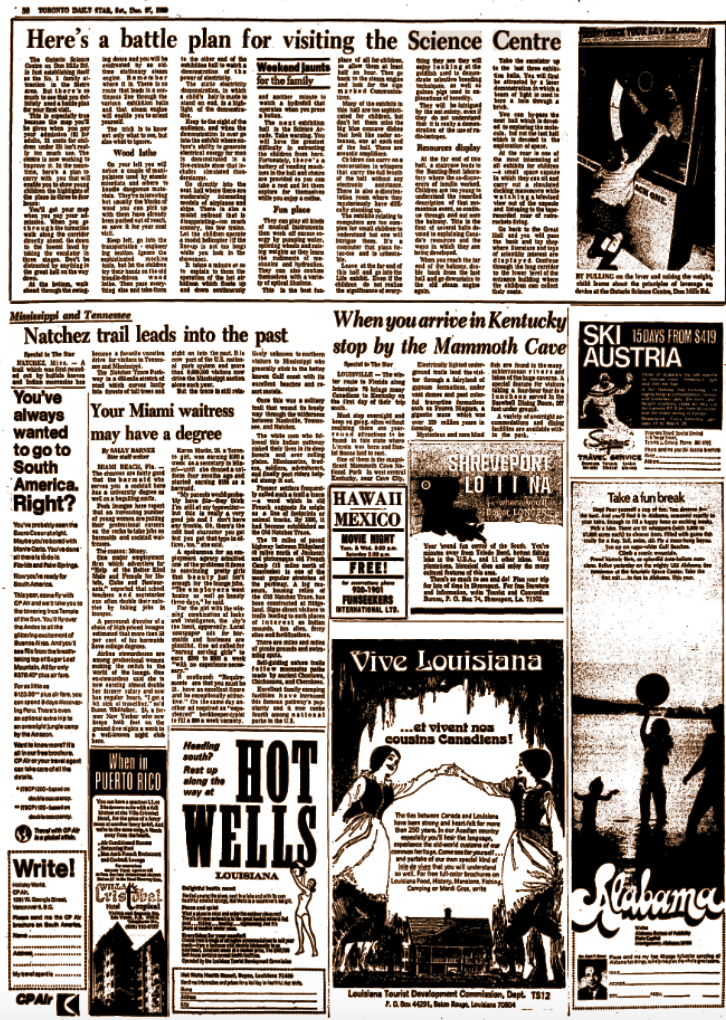
Going Boldly, 1992, Toronto Star Archives, TSPA_0110339F
She’s Sandy Samaroo!, 1984, Toronto Star Archives, TSPA_0110330F
Physics, 1969, Toronto Star Archives, TSPA_0110351F
Space. Visitor Deena Sproule, 1969, Toronto Star Archives, TSPA_0110360F
Cohen, Ben. “Inspiring, interactive, memorable, exciting’: A short history of the Ontario Science Centre,” Toronto Star, July 12, 2025, https://www.thestar.com/news/gta/inspiring-interactive-memorable-exciting-a-short-history-of-the-ontario-science-centre/article_6153efc8-2ff9-11ef-a385-b3675fb80aaf.html
Ross, Morgan Cameron. “Thirty-three archival photos showcasing the history of the Ontario Science Centre,” Toronto Life, May 8, 2023, https://torontolife.com/city/thirty-three-archival-photos-showcasing-the-history-of-the-ontario-science-centre/
Teles, Anthony. “Ground Broken for Ontario Science Centre at Ontario Place,” Urban Toronto, May 26, 2026, https://urbantoronto.ca/news/2026/05/ground-broken-ontario-science-centre-ontario-place.61058
Motluk, Alison. “The Killing of the Science Centre,” The Local, November 25, 2024, https://thelocal.to/ontario-science-centre-closed/
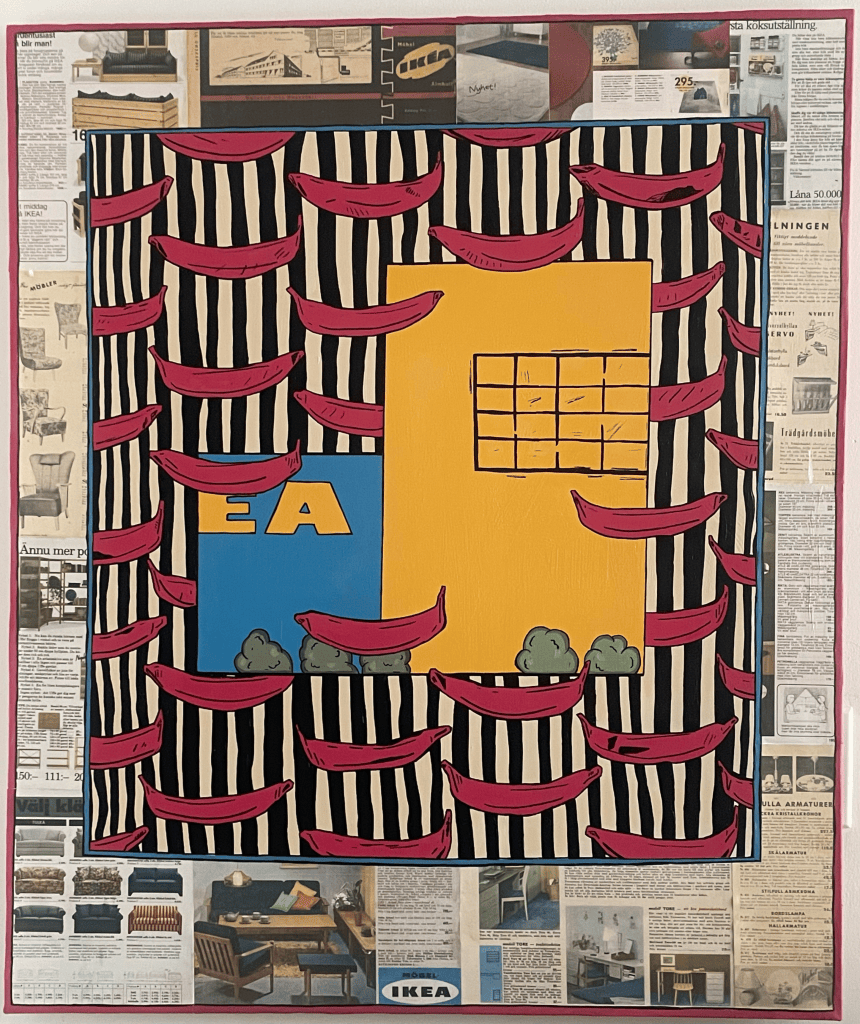

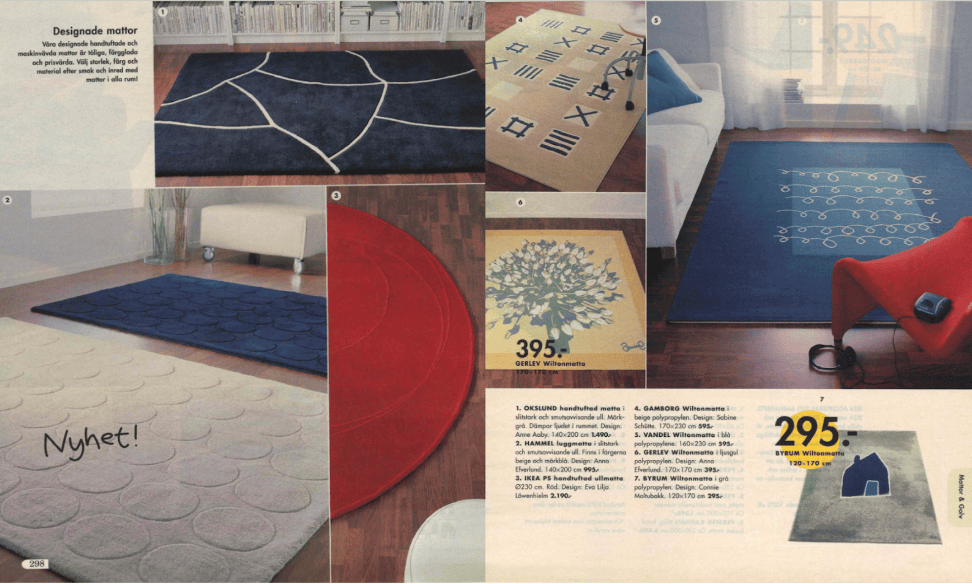
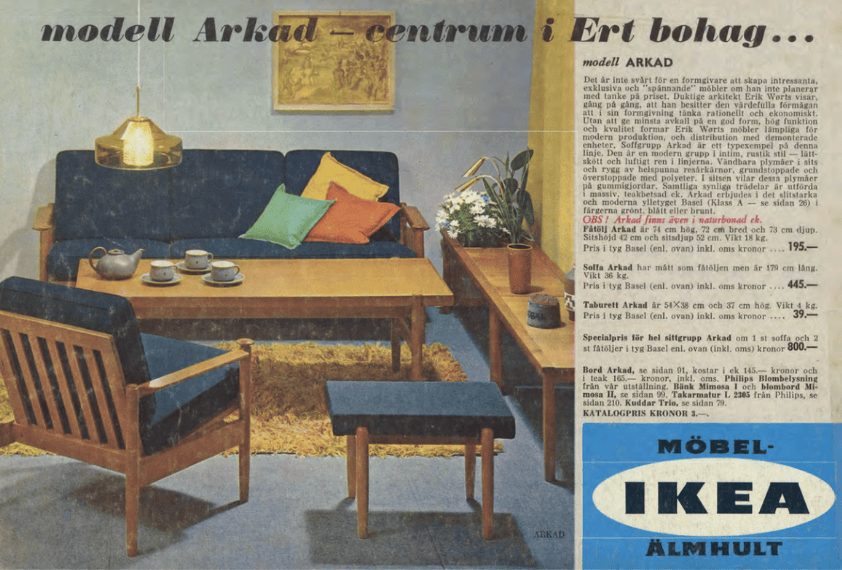
“Välkommen hem” is how we say it in Swedish
32 x 36”
Mixed Media On Canvas
February 2026
MEMORY
I have vivid memories of going to IKEA while growing up. I remember the smell of the cinnamon rolls and the chatter in the restaurant, where my mom would push two carts filled with veggie balls and rice. I remember playing house in the furniture showrooms, imagining the rooms and lives I could live within those displays. I remember the smell of wood in the warehouse and the sight of families with trolleys piled high with boxes. I remember receiving IKEA catalogues in the mail and flipping through them, circling mismatched tables and kitchen cabinets for my future home. I question the sense of home I felt at ten years old within a mass-produced furniture store we visited only occasionally. Yet, that feeling of comfort and possibility has since stayed with me. Now, at twenty-three, I find myself returning to IKEA’s downtown store, wandering through the aisles and choosing bed frames and dining tables that I will never buy. When will I stop longing for these objects that only fill a house? When will my tiny apartment begin to feel like home? Maybe one day, when I have a big job playing dress-up in business attire, living in a house that I own with a porch and a swingset. If only.
HISTORY
Throughout the late twentieth and early twenty-first centuries, accessible commercial spaces became increasingly important within Toronto’s urban landscape, especially for working-class communities. IKEA created an environment where customers could browse room displays, eat affordable meals, and spend hours exploring the store, whether or not they intended to make a purchase. The store turned furniture shopping into a leisure and social experience. IKEA was founded in 1943 by seventeen-year-old Ingvar Kamprad in Älmhult, Sweden. Inspired by his rural hometown of Småland, Kamprad initially sold household goods before expanding into furniture. Because Älmhult’s remote location, IKEA introduced its catalogue in 1951 to reach customers in larger cities, where this emphasis on accessibility, affordability, and practical design became central to IKEA’s identity as it expanded internationally. IKEA entered the Canadian market in 1976 with its first formal location in Richmond, British Columbia, followed by its North York store in 1977. Its expansion into the Toronto region reflected changing patterns of housing, consumption, and affordability as more residents sought functional furniture for apartments, rental homes, and smaller living spaces. Beyond its products, IKEA’s restaurant and family-oriented environment helped make it a social destination rather than just a retail store. As downtown neighbourhoods face rising costs and increasing commercialisation, affordable commercial experiences have increasingly moved away from the city centre. The importance of accessible public-facing spaces and the challenge of maintaining affordability within a rapidly changing city highlights this history of how commercial environments can serve social functions beyond consumption, providing spaces where diverse communities can gather and participate.
SOURECED MATERIAL
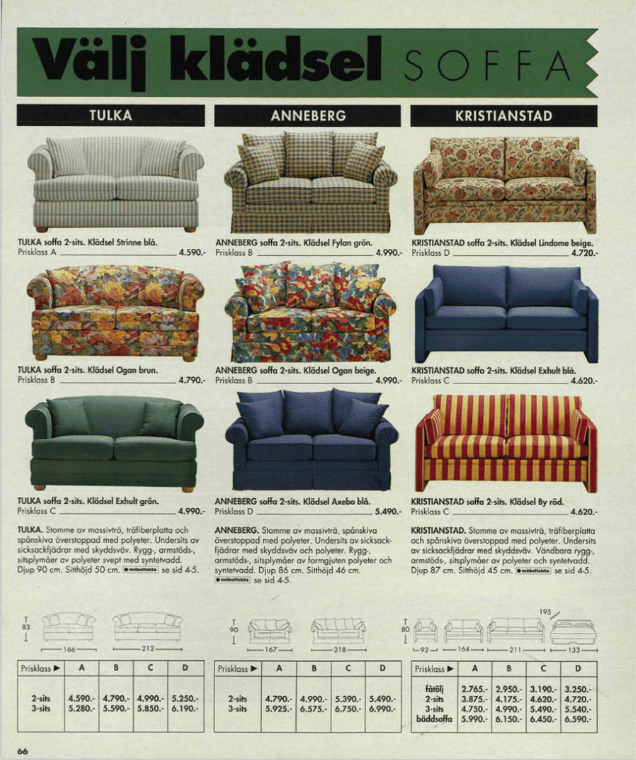
1950 IKEA Catalogue. IKEA Museum, Älmhult, Sweden. https://ikeamuseum.com/en/explore/ikea-catalogue/1951-ikea-catalogue/
1976 IKEA Catalogue. IKEA Museum, Älmhult, Sweden. https://ikeamuseum.com/en/explore/ikea-catalogue/1976-ikea-catalogue/
1990 IKEA Catalogue. IKEA Museum, Älmhult, Sweden. https://ikeamuseum.com/en/explore/ikea-catalogue/1990-ikea-catalogue/
2000 IKEA Catalogue. IKEA Museum, Älmhult, Sweden. https://ikeamuseum.com/en/explore/ikea-catalogue/2000-ikea-catalogue/
Lamare, Amy. “A brief history of IKEA: From cheap bookcases to Swedish meatballs.” The Business of Business, August 19, 2020. https://www.businessofbusiness.com/articles/ikea-history-founder-data-hiring/
“The Story of IKEA.” IKEA Museum, 2026. https://ikeamuseum.com/en/explore/the-story-of-ikea/
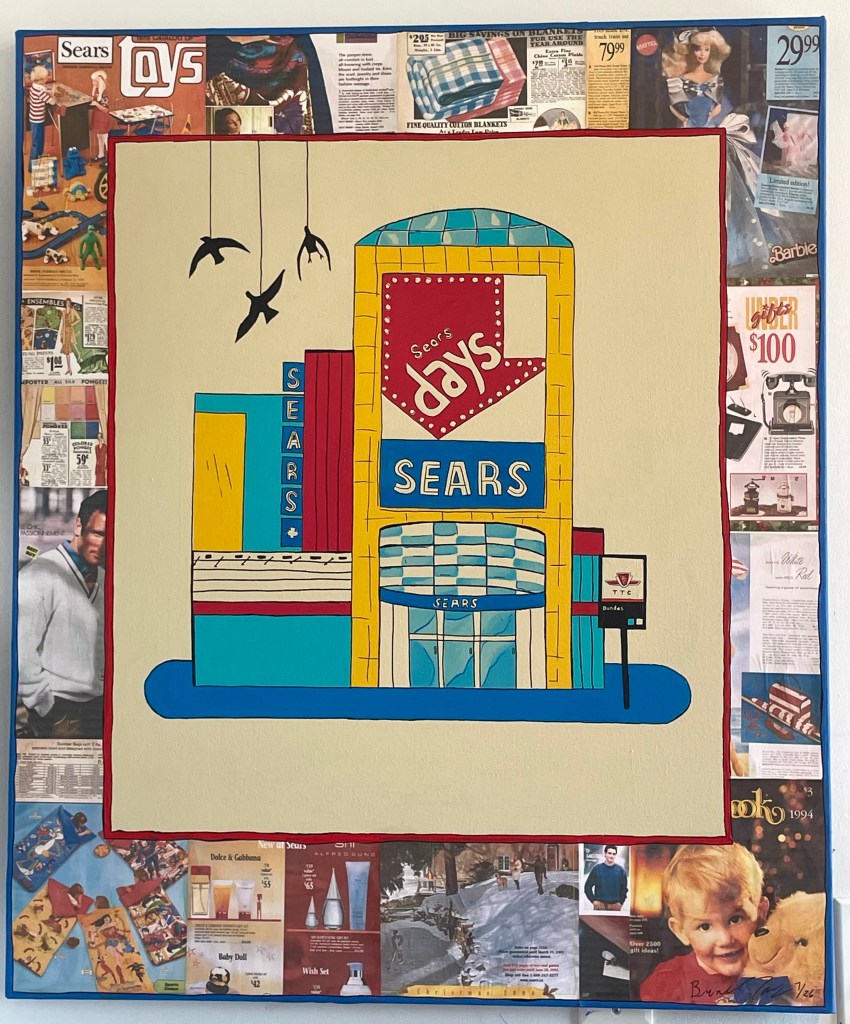

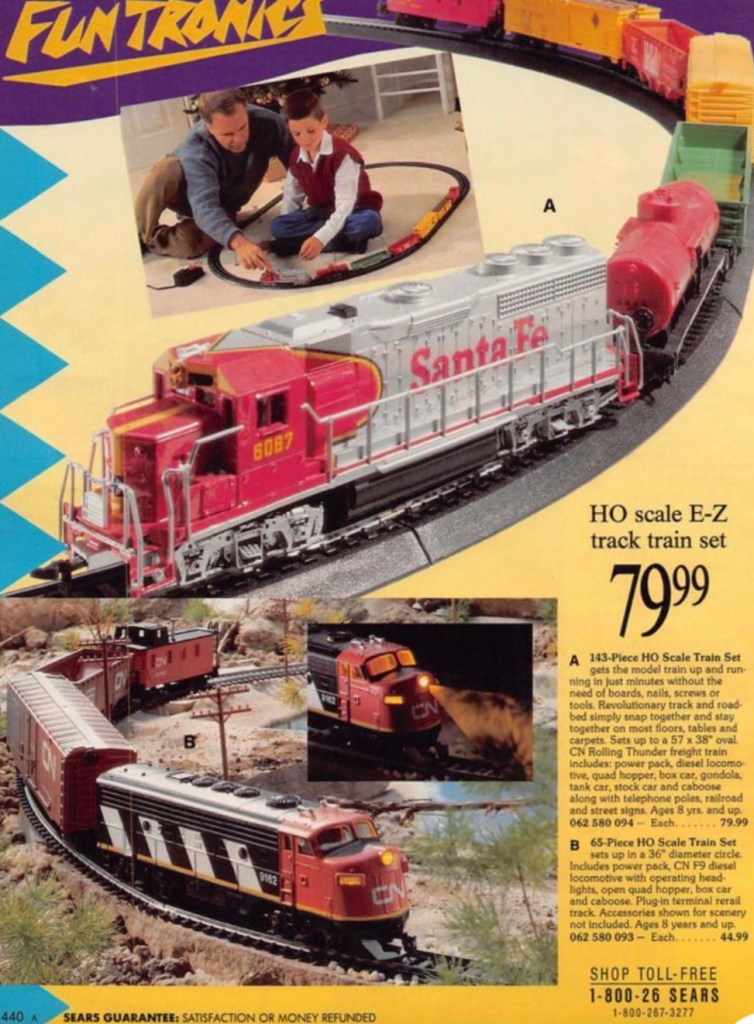
How To: Master Window Shopping At The Age Of 10
32 x 36″
Mixed media on Canvas
July 2026
MEMORY
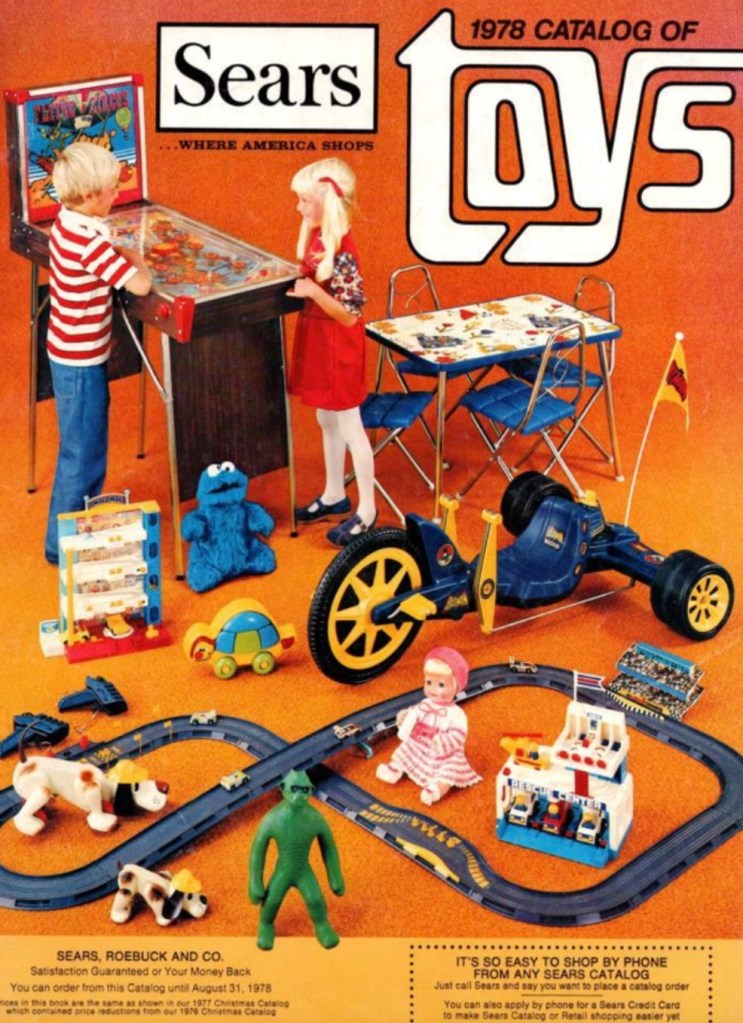
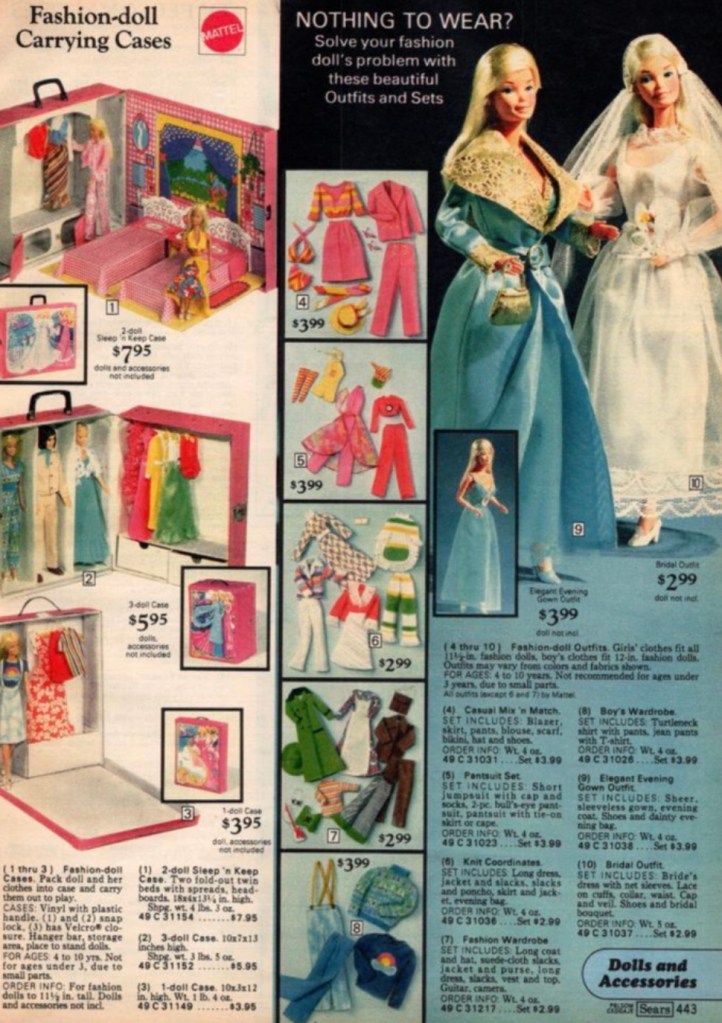
Some weekends we went to the Eaton Centre as our daily activity. It was a pretty entertaining place for a single mother of 3. They had the Disney store, McDonald’s by Hudson’s Bay (where we’d split a muffin into 4), and Sears. I loved Sears. I loved that it had everything, and I loved imagining my grown-up self going to a department store and buying whatever I wanted. I looked at the patio furniture and imagined my future house with a really big backyard, and I looked at the high heels and dresses and imagined myself having a walk-in closet like Jenna in 13 Going on 30. When I think of Eaton’s, I think of department stores. First there was Eaton’s, then Sears, Nordstrom, and now Simons. I wander Simons sometimes to pass the time, but it’s different now. At 10 years old, I thought that 10 years from now I’d have all the money in the world, but now I know that I have food at home.
HISTORY
Department stores transformed urban retailing in the late nineteenth century by redefining shopping as both a commercial and social experience. Unlike earlier shops, they introduced fixed pricing, open browsing, and return policies. In Toronto, this transformation showed up in new commercial architecture: multi-storey buildings with large display windows and open floor plans that encouraged window shopping.
Timothy Eaton’s dry-goods store, founded in 1869, became an icon for this new retail culture. By 1883, Eaton had opened a multi-storey department store at the North side of 178 Yonge Street featuring elevators and thirty-five departments. His cash-only, fixed-price system and mail-order catalogue made consumer goods accessible to working- and middle-class Canadians nationwide. Simpson’s department store, at the Southwest corner of Yonge and Queen Street at 176 Yonge Street in 1880, similarly expanded the range of goods available. Nearby, the Yonge Street Arcade, opened in 1885 as Canada’s first indoor shopping mall, housed fifty-two small businesses and reflected downtown Toronto’s growing commercialisation, expanding from 137 Yonge Street to 74 Victoria Street, now the Arcade Office Building.
By the late twentieth century, however, suburban shopping malls, changing consumer habits, and later the rise of e-commerce reshaped retail. The Hudson’s Bay Company, which acquired Simpsons in 1978 and completed its rebranding in 1991, struggled to adapt to increasing competition from fast-fashion retailers, online shopping, and changing consumer habits. An American businessman first bought the company in January 2006 for $1.1 billion, and the U.S. private equity firm NRDC Equity Partners acquired it in July 2008, further emphasising luxury retailing and distancing the company from its traditional customer base. The closure of Hudson’s Bay stores in the 2020s marked the end of the era when department stores defined downtown Toronto’s commercial and social life.
SOURCED MATERIAL
1974 Sears Fall Winter Catalog, Sears, Internet Archives, https://archive.org/details/0001_20250218
Great American Wishbook 1991, Sears, Internet Archives, https://archive.org/details/great-american-wishbook-1991_202303
Sears Canada Wishbook 1999, Sears, Internet Archives, https://archive.org/details/sears-canada-wish-book-1999
1946 Sears Fall Winter Catalog, Sears, Internet Archive, https://archive.org/details/1946-sears-fall-winter-catalog_202307
Martin, Lucy. “Timothy Eaton and the T.Eaton Company,” Rideau Township Historical Society, February 2012. https://rideautwphistory.org/timothy-eaton-and-the-t-eaton-company/
“Eaton Centre,” A View on Cities, 2012, https://aviewoncities.com/toronto/eaton-centre
Marie, Denise. “Eatons College Street Store: An Art Deco Architectural Treasure,” TorontoJourney416, July 10 2026, https://www.torontojourney416.com/eatons-college-street/

He Only Came Home for $5 Tuesdays
32 x 38″
Mixed Media on Canvas
March 2026
MEMORY
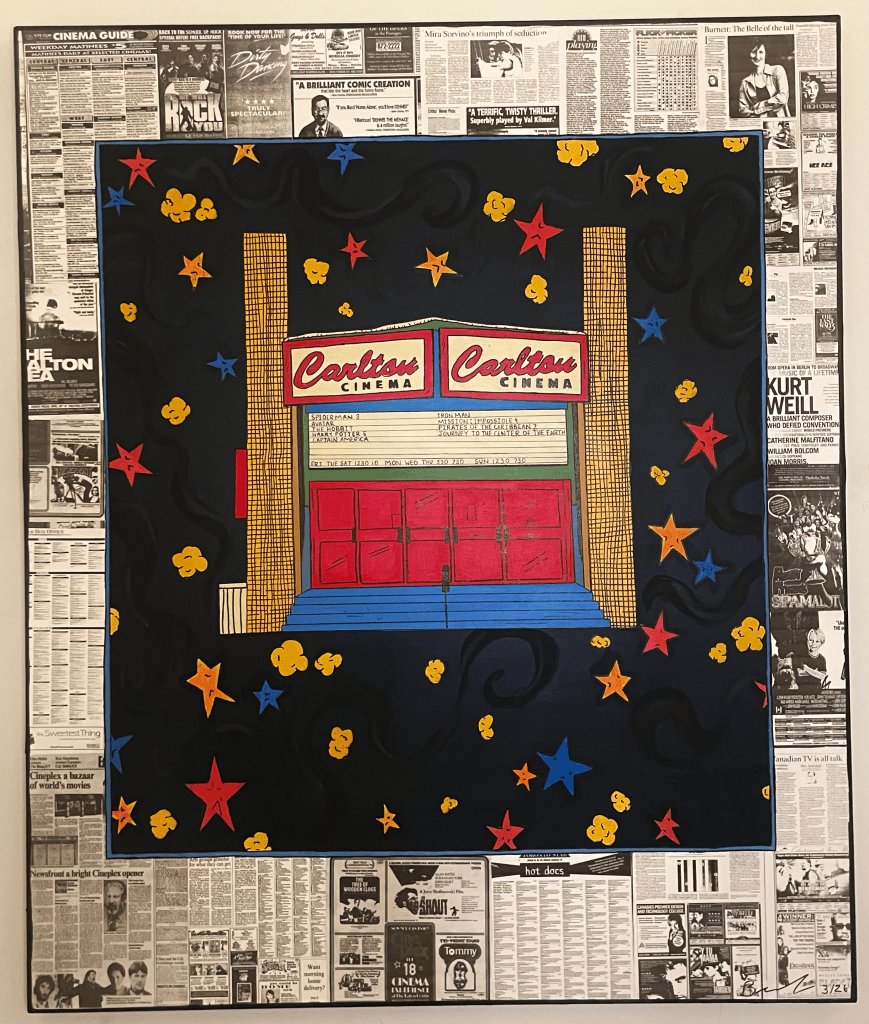
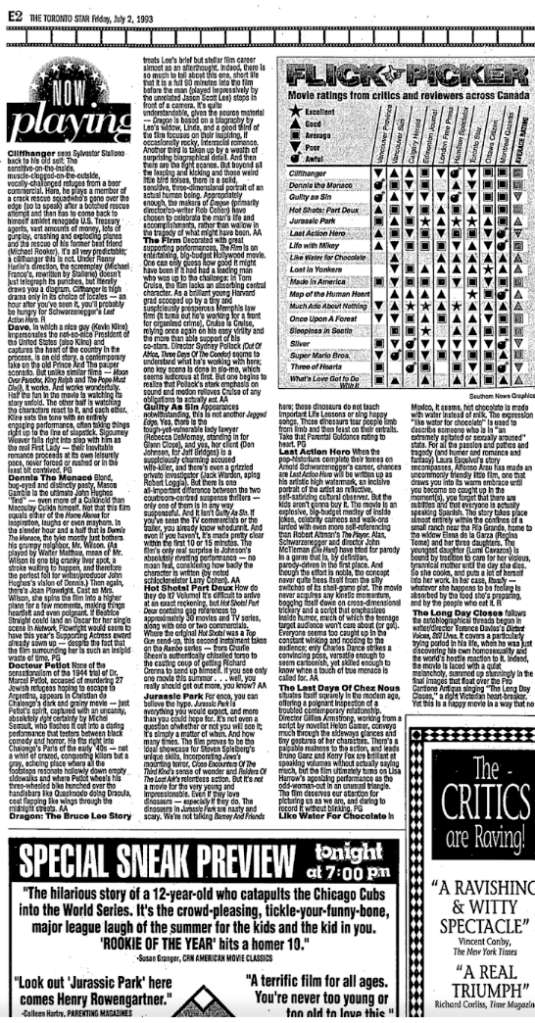
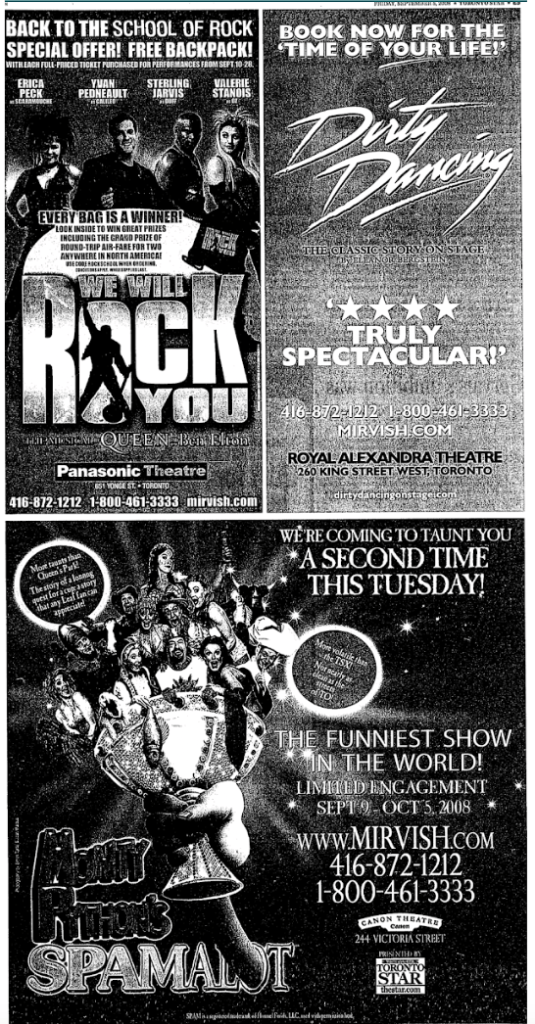
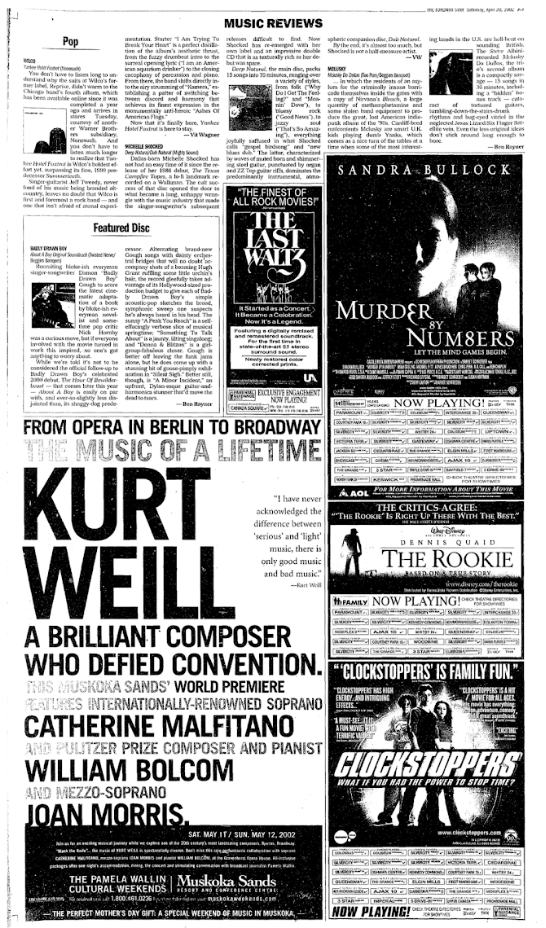
Carlton Cinemas was less than a 10-minute walk from our house, yet we still only went on the occasional Tuesday. My dad came home on Tuesdays. I remember my mom doodling in the Sudoku boxes in the Toronto Star, then giving us the rest of it when she was done. I’d look at the Entertainment section and ask my mom about the shows playing on Tuesday. Here’s what I remember from our Tuesday Movie Nights: it was busy, we smuggled in my little sister, and we always passed the concession stand because we brought microwave popcorn from home. I remember my sisters and I always sat on two booster seats to see the screen, even though we didn’t want to watch the movies. My dad always picked the movies. I always wondered why I constantly rewatch Doctor Strange and Spider-Man 3. I wonder why my eyes light up when I go to the movies, and why my heart aches for my dad, who now goes to the movies on days that are not just Tuesdays.
HISTORY
Throughout the twentieth century, neighbourhood movie theatres were among Toronto’s most important public gathering spaces for working-class and immigrant communities. Beyond entertainment, cinemas offered affordable access to news, social interaction, and temporary escape during periods of economic hardship throughout the Great Depression and the Second World War. Before television became common, local theatres functioned as community centres where residents gathered to share experiences and remain connected to local and international events. Venues like La Salle Theatre in Kensington Market attracted audiences with inexpensive admission and creative promotions, including giveaways of household goods.
The Odeon-Toronto, built at 20 Carlton Street in 1947, was designed in a Modern style with an 80-foot stone tower visible from surrounding blocks; it was one of Ontario’s largest single-screen theatres. The cinema officially opened in 1948 with Oliver Twist and was renamed the Odeon Carlton in 1956. As television ownership expanded and operating costs increased, attendance declined. Plans to convert the building into a permanent home for the Canadian Opera Company were ultimately rejected by the City of Toronto, and the theatre was demolished in 1973. The site was later redeveloped as the Maple Leaf Gardens and Toronto Hydro towers. In 1981, Carlton Cinema opened on the ground floor of The Maples, continuing the site’s long association with cinema.
As redevelopment and rising living costs continue to reshape Toronto, spaces that offer inexpensive cultural experiences have become increasingly rare. This history reflects the importance of preserving a city’s cultural heritage by protecting buildings and maintaining public spaces where diverse communities can gather, participate, and access culture regardless of income.
SOURCED MATERIAL
“Page E16.” Toronto Star (1971-2009), Sep 05, 2008. https://www.proquest.com/newspapers/page-e16/docview/1348845103/se-2.
“Page E12.” Toronto Star (1971-2009), Jul 02, 1993. https://www.proquest.com/newspapers/page-e12/docview/1370698988/se-2.
“Page D1.” Toronto Star (1971-2009), Jan 26, 2007. https://www.proquest.com/newspapers/page-d1/docview/1348994744/se-2.
“Page 23.” Toronto Daily Star (1900-1971), Aug 08, 1969. https://www.proquest.com/newspapers/page-23/docview/1419932460/se-2.
“Page 21.” Toronto Daily Star (1900-1971), Feb 23, 1963. https://www.proquest.com/newspapers/page-21/docview/1426767664/se-2.
“Page 28.” Toronto Daily Star (1900-1971), Nov 14, 1969. https://www.proquest.com/newspapers/page-28/docview/1419248738/se-2.
“La Salle Theatre, Originally the Liberty”, TorontoJourney416, June 21, 2022. https://www.torontojourney416.com/la-salle-theatre/
Butters, Christopher. “A Look Back at Toronto’s Old Movie Theatres”, Toronto Guardian, October 14, 2012.
https://torontoguardian.com/2012/10/a-look-back-at-torontos-old-movie-theatres/
Hughes, Felix. “Interview: Giving Toronto’s historic cinemas their close-up”, Next Magazine, June 4, 2026,
https://nextmag.ca/interview-giving-torontos-historic-cinemas-their-close-up/
Xenophontos, Theodore. “From La Plaza to the Opera House: A History of Change”, Local Film Cultures: Toronto, October 12, 2012.
https://localfilmculturestoronto.wordpress.com/exhibition-sites-case-studies/from-la-plaza-to-the-opera-house-a-history-of-change/
August 19
28 x 34″
Mixed media on canvas
August 2026
Memory
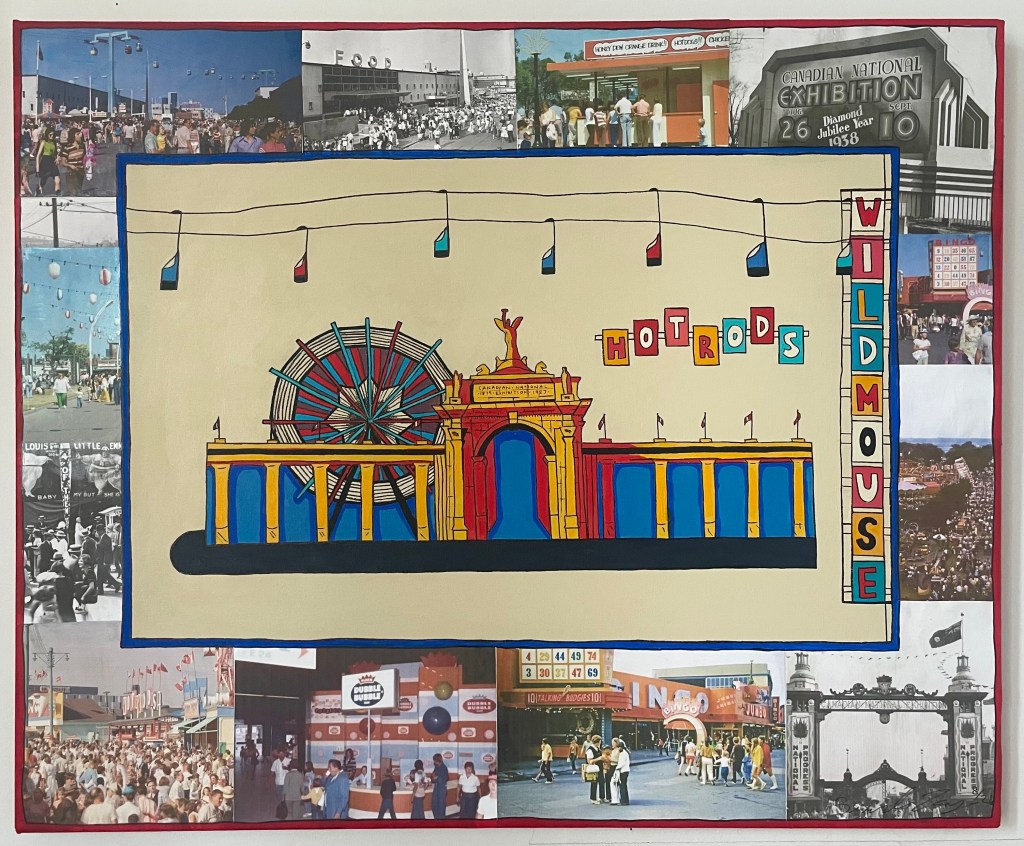
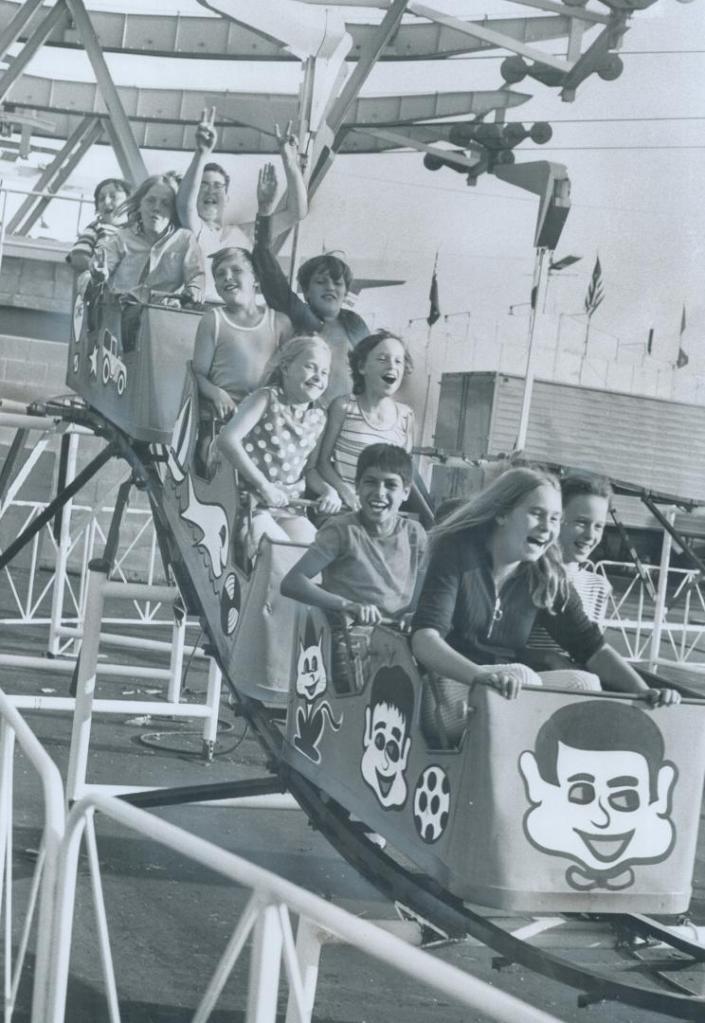
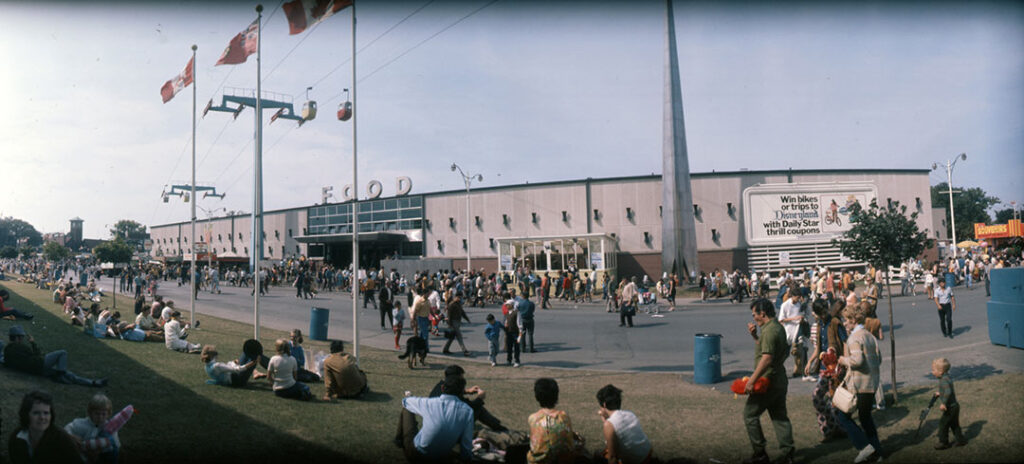
We always went to the CNE for my dad’s birthday. We always got admission passes after school ended, so opening day became a family tradition. We rode the mouse trap ride and ate Tiny Tom doughnuts. I remember being happiest on this one day of the year, and that’s all I remember about the CNE. My dad and his brother went to the CNE using those very same admission passes they got from school back in the 70s. They ate free samples at the Food Hall and watched the live shows. When my dad was old enough to work as a paperboy, he saved enough money for them to finally go on the rides. It was a tradition for them to go every year until they went away for college. It’s been years since we’ve all gone together as a family. There are so many things that I once called traditions that we no longer do. I guess that’s what growing up is, leaving behind some traditions and carrying on others. Maybe this is something I’ll carry on.
HISTORY
When the Toronto Industrial Exhibition opened in 1879, it was designed to bring people together to see the achievements of Canadian agriculture, industry, and the arts. Interestingly, the Crystal Palace was the only building dedicated to agriculture. Admission cost only a quarter, making the exhibition accessible to many ordinary Torontonians, and more than 100,000 paid admissions were recorded in its first year. The fair was officially renamed the Canadian National Exhibition (CNE) in 1912. At its peak, the fairgrounds covered 141 hectares and included one of the world’s finest amusement parks and permanent exhibition facilities. In 1927, HRH Edward opened the Princes’ Gates. Originally, nine pillars represented Canada’s nine provinces at the time, topped by the figure known as the “Goddess of Winged Victory.” Following a major restoration in 1987, the gates were designated as historically significant under the Ontario Heritage Act. During the First World War, the exhibition grounds served as an Exhibition Camp for military training and housing, while the CNE continued to operate and display weapons and war trophies. By the 1960s, the CNE had evolved into a consumer marketplace, showcasing new automobiles, appliances, and computers. The pedestrian bridge spanning Lake Shore Boulevard connected Exhibition Place to the Ontario Place grounds, allowing visitors to access both sites. Ontario Place opened in May 1971, featuring a futuristic architectural design by Eberhard Zeidler, the world’s first permanent IMAX theatre, the Cinesphere, the Forum amphitheatre, and the Children’s Village. The Forum was later demolished and replaced by what is now Budweiser Stage. The Cinesphere and Pods were later recognised as cultural heritage resources. Although Ontario Place closed in 2012, the site remains the subject of redevelopment proposals, including plans for a large spa and entertainment complex by the Therme Group.
SOurced material
Food Building Panorama, 1960s, CNE Archives
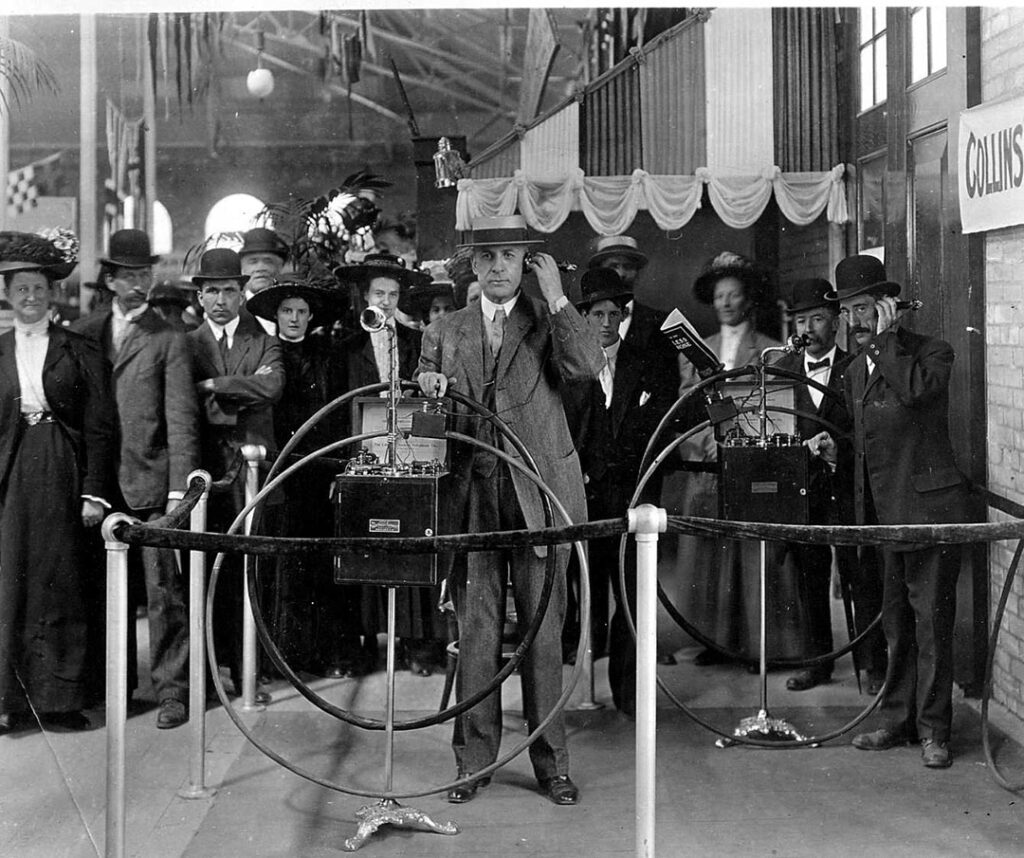
1888 Telephone Demonstration, 1888, Mike Filey Collection, CNE Archives
1897 Programme Front Cover, 1897, CNE Archives
“CNE opens – and the good times roll again, The magic, magnetic midway and its mini-roller coaster ride were the first order of business for these chil”, 1971, Toronto Star Archives
Marie, Denise. “CNE & Exhibition Place – Part of Toronto’s History for Over 145 Years,” TorontoJourney416, August 11 2021, https://www.torontojourney416.com/cne-canadian-national-exhibition/
Marsh, James H. “Canadian National Exhibition,” Canadian National Encyclopedia, October 23, 2026, https://thecanadianencyclopedia.ca/en/article/canadian-national-exhibition
“Ontario Place: Vision of the Future,” Heritage Toronto, 2025, https://www.heritagetoronto.org/explore/toronto_harbour_waterfront_history/ontario-place-toronto-history/
Stall-Paquet, Caitlin. “Lake Effect,” Toronto Life, August 22 2023, https://torontolife.com/city/ontario-place-history-archival-photos
Bradburn, Jamie. “Ontario Place,” Canadian National Encyclopedia, January 20, 2022, https://thecanadianencyclopedia.ca/en/article/ontario-place
This Is Not About A Strip Club
32 x 36″
Mixed media on canvas
July 2026
MEMORY
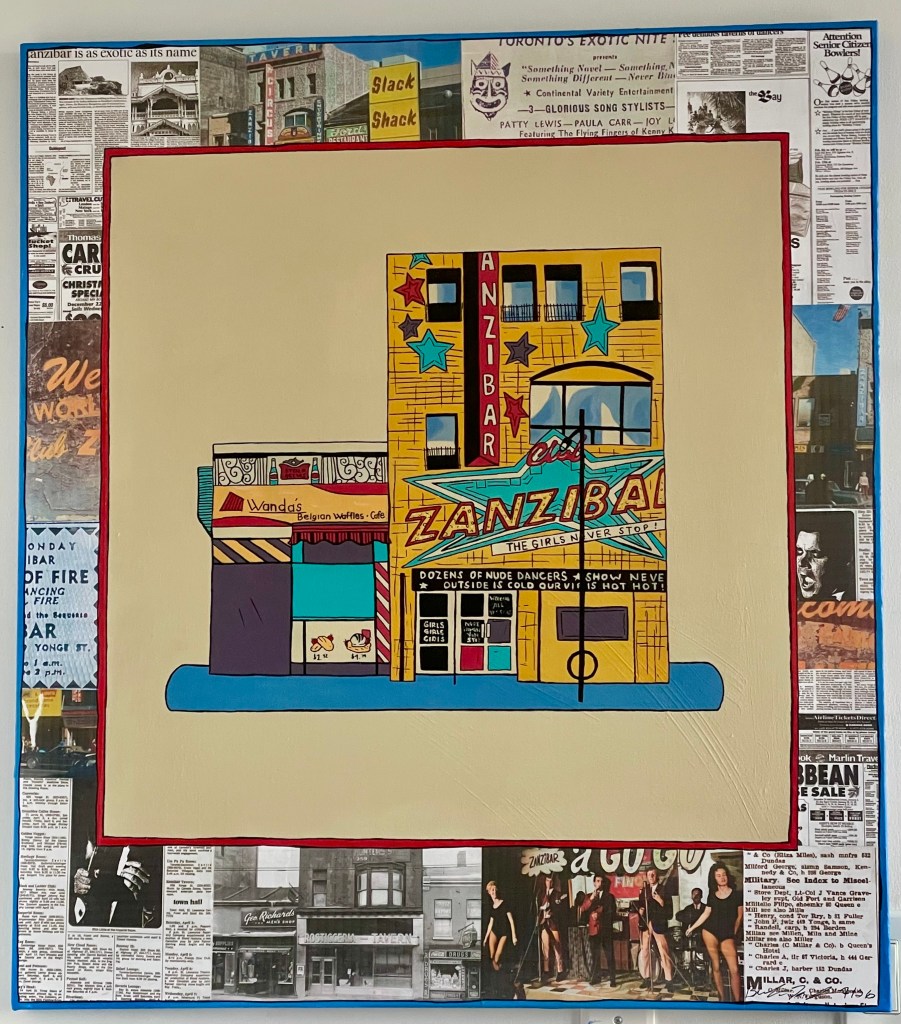
I have this very specific memory of going to Nathan Phillips Square for the Cascades of Lights, and on the way back we’d pass this waffle place. I remember the smell of warm waffles and the happy people inside the tiny shop. I remember, every time, my dad staring inside, looking at the $4.49 waffle price, then walking by. When I finally got a job that paid $14.10 an hour, I started searching for the missing part of me: Wanda’s Belgian Waffles. It closed in 2024. I longed for supposed $5 waffles and to satisfy my cravings for warm waffles and ice cream at 12 am in downtown Toronto. I guess instead I can buy a joint at each of the 10 cannabis stores on Yonge St, which now sits where Wanda’s once did. How many more things have changed since then? The cool fashion store that blasted music on the street? Gone. Sugar Mountain, which I begged my mom to take me to? Gone. Surprisingly, the Pizza Pizza at College and Yonge that my dad got for my birthday party is still around. Thank god for that.
HISTORY
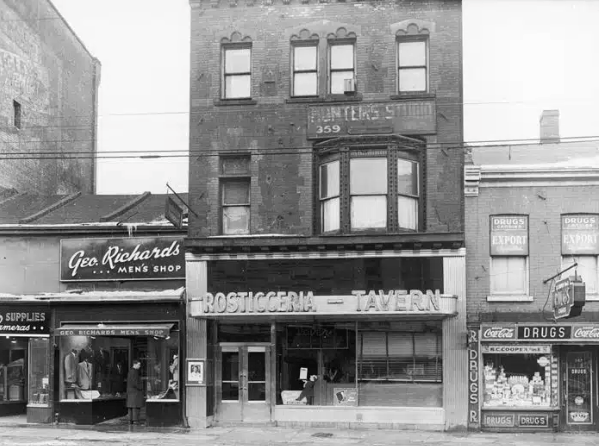
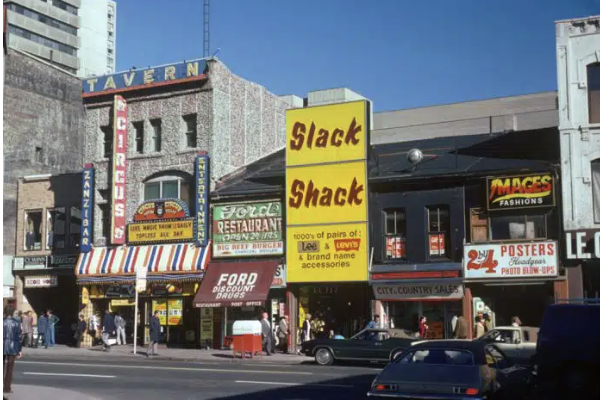
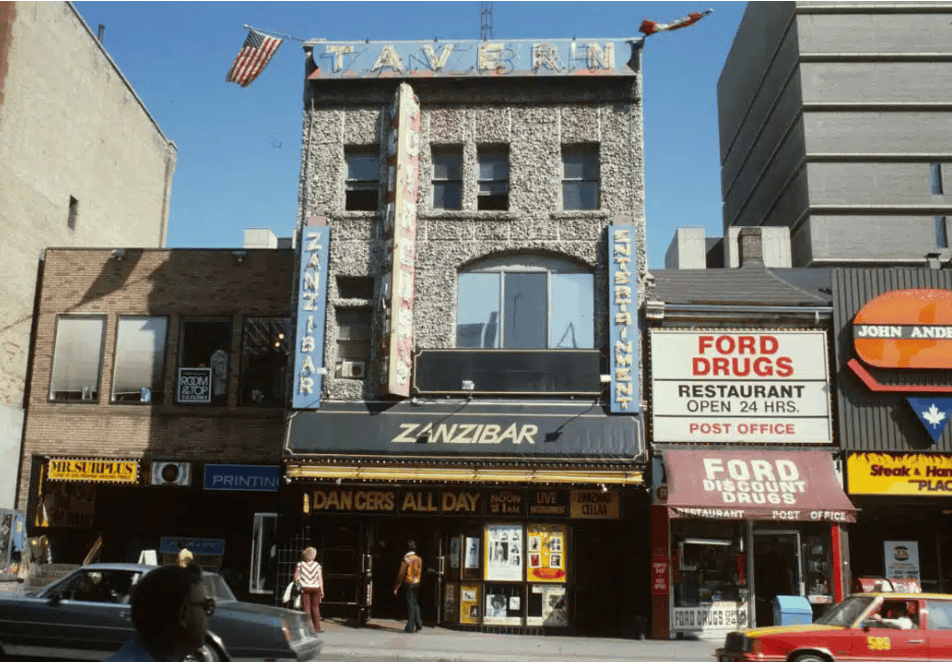
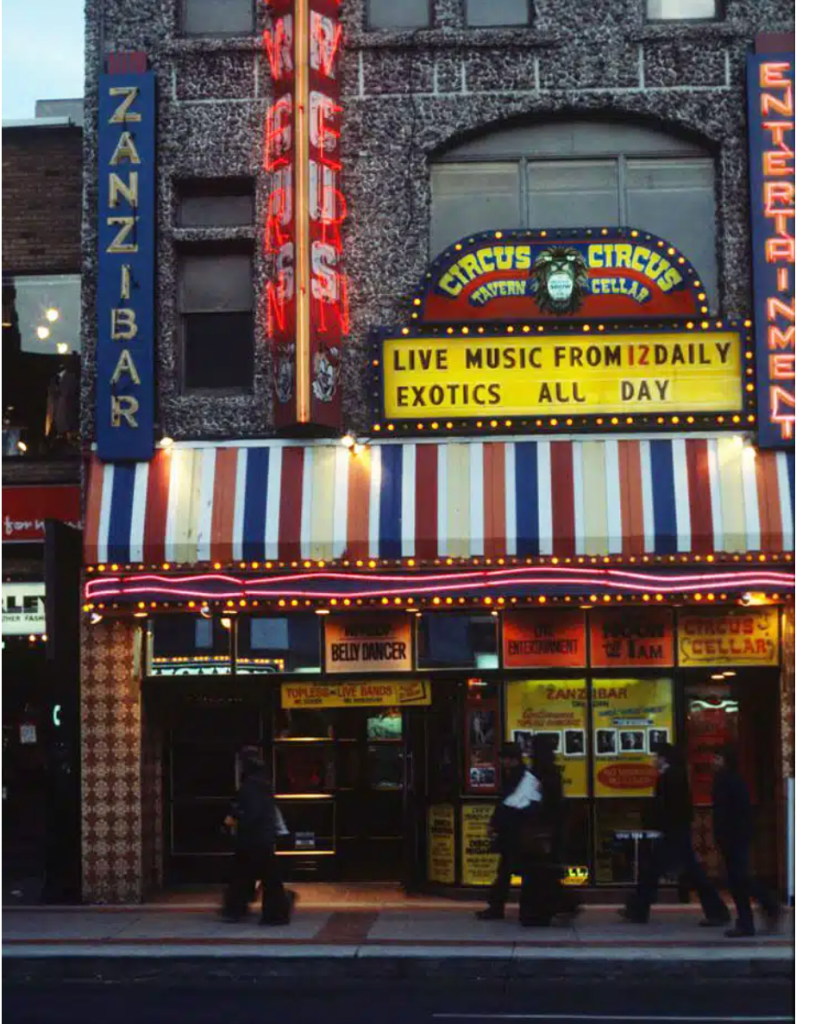
While heritage designation aims to preserve these historic buildings, protection has often been uneven, raising questions about which histories are considered worthy of preservation and when preservation efforts occur. Throughout the twentieth century, Yonge Street became synonymous with entertainment, music, and nightlife. One of its longest-standing landmarks, Club Zanzibar at 395 Yonge Street, reflects downtown Toronto’s continual transformation. Built in 1895 for Leading Undertaker, the building originally served as a funeral home before housing piano companies, photo studios, and cafes from the 1910s to the 1940s. In 1947, the space became The Rosticceia, marking its transition into a restaurant. Following a complete redesign in 1951, it reopened as The Zanzibar Tavern, offering affordable meals and live entertainment, including its $1.25 roast chicken dinners in 1953. After Davis Cooper purchased the tavern in 1961, the venue adapted again, introducing go-go dancers in 1965 to capitalise on the go-go craze. Alongside neighbouring establishments like Steele’s Tavern, Zanzibar became part of Toronto’s music scene, helping launch the careers of Canadian musicians including Gordon Lightfoot. By the 1970s, however, it had been renamed the Zanzibar Circus Tavern, marking its shift from a live music venue to an adult entertainment establishment, and the building finally took on its present appearance after a $300,000 renovation in 2001. Despite more than 125 years of significance to Toronto’s cultural history, 395 Yonge Street remains without heritage designation. Recently, on August 16, 2026, a three-alarm fire severely damaged the Zanzibar building, compromising its roof and upper floors and leaving its future uncertain. The fire serves as a recent reminder of how quickly the physical spaces that carry Toronto’s cultural histories can become vulnerable to loss. The loss of the Empress Hotel at 335 Yonge Street after a 2011 fire further exposed the limits of Toronto’s heritage policies. Although designated under the Ontario Heritage Act, years of neglect and legal disputes ultimately led to the demolition of one of Yonge Street’s last nineteenth-century commercial buildings. Toronto’s heritage requires more than protecting architecture; it also demands recognising the cultural histories embedded in the city’s evolving urban landscape.
SOurced material
Rosticceria Tavern and Hunter’s Studio at 359 Yonge St, 1950, City of Toronto Archives, Series 574, File 19, Item 49383.
Zanzibar Circus Tavern, 1975, City of Toronto Archives, Fonds 1526, File 3. Item 18.
Zanzibar in 1983, City of Toronto Archives, Series 1465, File 618, Item 41.
Zanzibar Circus Tavern entrance at 359 Yonge Street. 1970s. City of Toronto Archives, Series 1465, File 615, Item 17.
Mills, Carys. “Lawsuits tie up site of collapsed historic hotel,” The Globe and Mail, August 25, 2012
https://www.theglobeandmail.com/news/toronto/lawsuits-tie-up-site-of-collapsed-historic-hotel/article4499008/
Marie, Denise. “Zanzibar Tavern – A Building in the Body Business since 1895,” TorontoJourney416, May 11, 2024,
https://www.torontojourney416.com/zanzibar/
“The Heart of Music City: Zanzibar & Steele’s Tavern,” Heritage Toronto, 2026,
https://www.heritagetoronto.org/explore/music-city/zanzibar-steeles/
Jennings, Nicolas. “Toronto Cultural Landmark Lost”, NicolasJennings.com, January 24, 2011,
https://www.nicholasjennings.com/toronto-cultural-landmark-lost
Ervin, Michelle. “Yonge Street Blaze Has Ties to 905,” Streets of Toronto, January 25, 2011,
https://streetsoftoronto.com/toronto-culture/yonge-street-blaze-has-ties-to-905/
CBC News, “Zanzibar Tavern owner ‘devastated’ after Sunday morning fire”, CBC, August 16, 2026, https://www.cbc.ca/news/canada/toronto/zanzibar-downtown-toronto-fire-9.7309023
Always TD Bank First
32 x 36″
Mixed Media on Canvas
March 2026
MEMORY
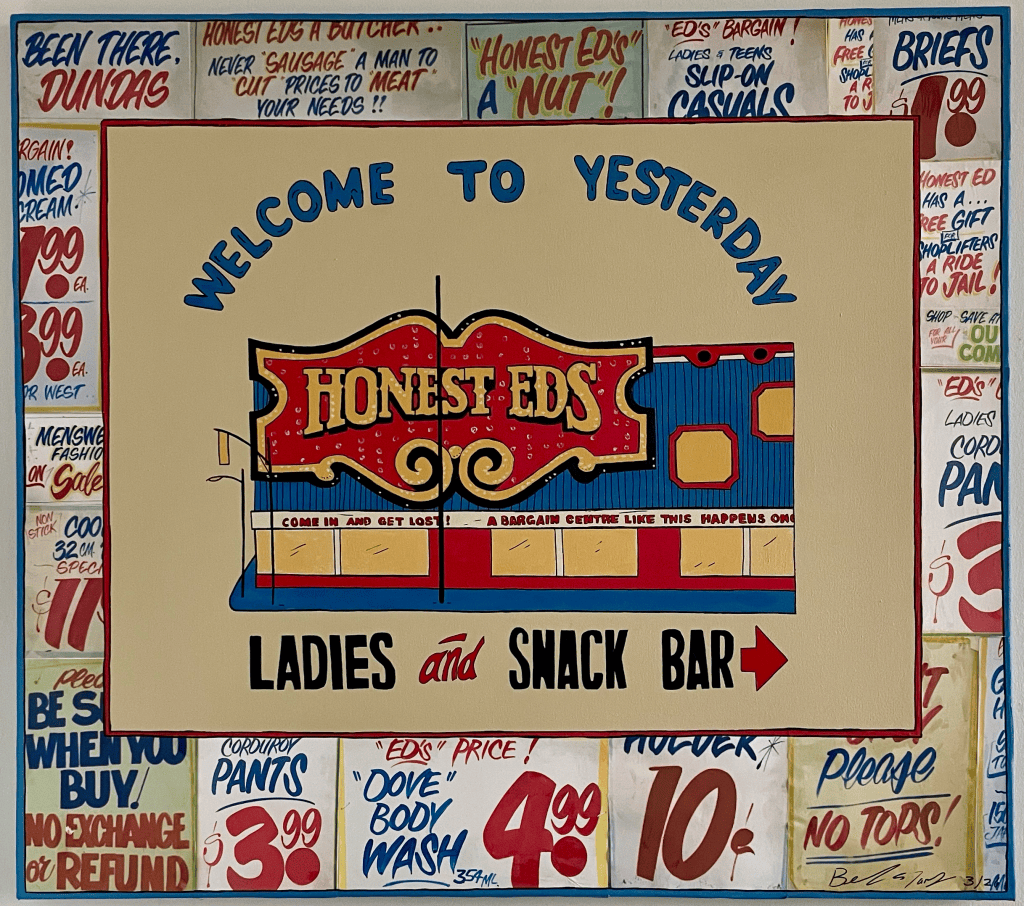
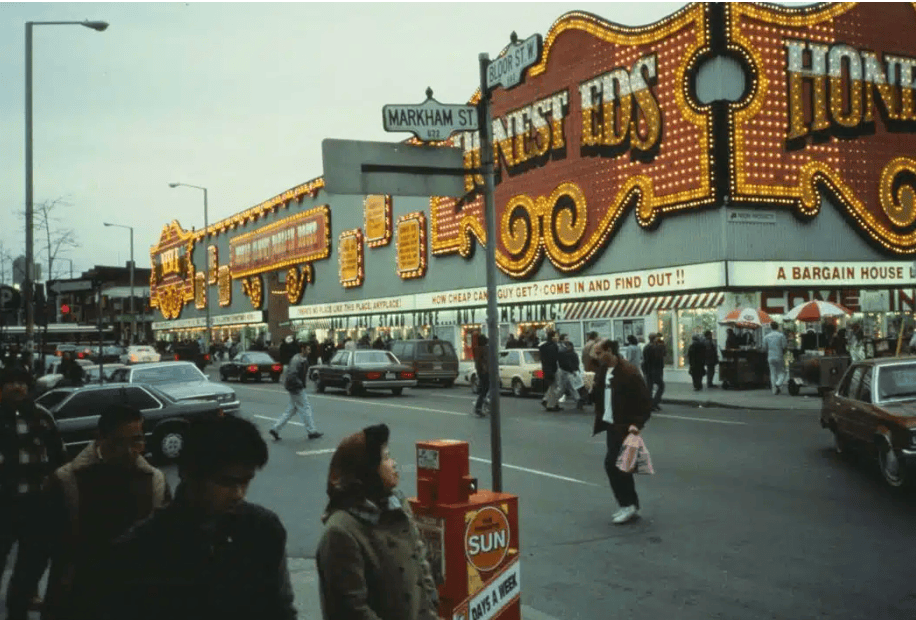
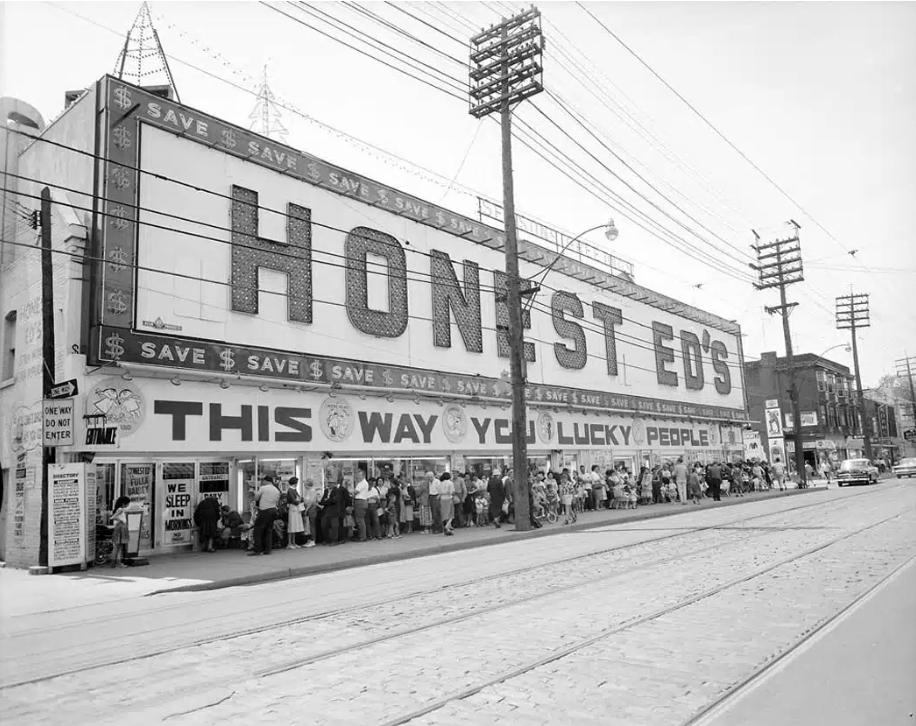
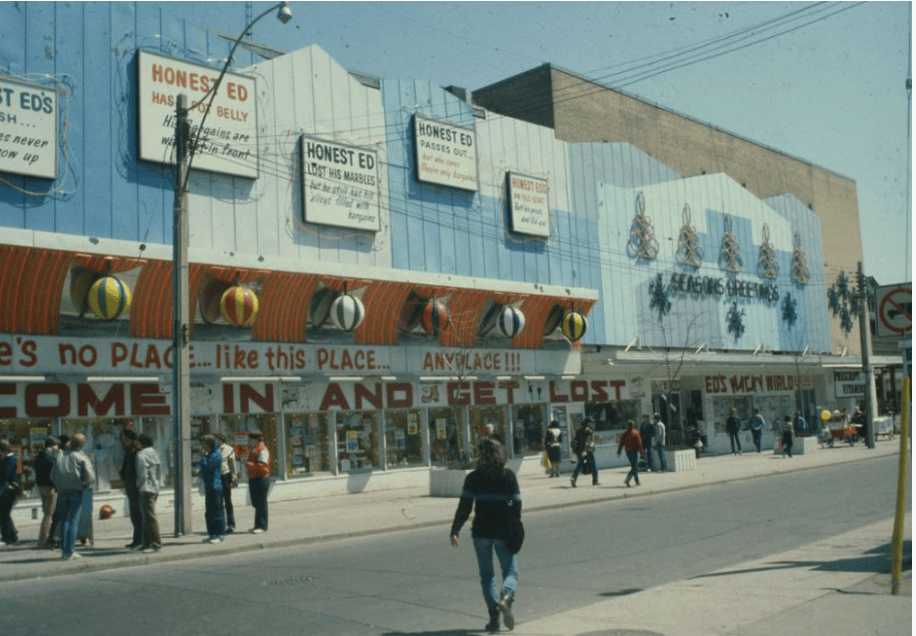
For some reason, my parents always needed to go to the TD Bank across the street before going to Honest Ed’s. My mom says that it was convenient, but I hated it. We sat in green chairs in the waiting area staring out the window hoping to leave soon. My sisters just wanted to play in the aisles, but I wanted to look at the signs I couldn’t read and pretend, looking at all the things I wanted but never got. We only went to my dad’s work shows, though. I remember when Honest Ed’s closed down in 2016. It was on the news, and we all gasped. At age thirteen, I didn’t understand why it needed to be replaced by a condo. Recently, I walked past Bathurst and Bloor and saw that same TD Bank across the street from now an affordable housing condo priced at 80% of average market rent. Now it’s Mirvish Village, a “vibrant community hub”. This new version of community is built over an old one that no longer welcomes my family, who window shopped at a bargain store.
HISTORY
Honest Ed’s was a social institution that reflected Toronto’s identity as a city where affordable goods and public gathering spaces were accessible to working-class residents. Opened by Ed Mirvish in 1948 at 581 Bloor Street and had a reputation for affordability and community engagement that welcomed people from all backgrounds. The store also supported the surrounding collection of independently owned bookstores, restaurants, and small businesses in the Annex. After Ed Mirvish’s death in 2007, his son, David Mirvish, managed the businesses and the store for nearly a decade until he sold the 3.47-acre property to Westbank Corp in 2013, closing the retail store in December 2016. As property values increased, the property was demolished and redeveloped into a large mixed-use complex centred on condominium housing, retail, and public space. Although the redevelopment includes units described as “affordable housing priced at 80% of average market rent, that defines affordability that reflects contemporary market conditions rather than the economic realities of the average lower-income Torontonian. Replacing a low-cost shopping destination with higher-density residential development illustrates the growing tension between urban intensification and social accessibility.
The history of Honest Ed’s raises broader questions about heritage in Toronto. While preservation efforts often focus on architectural façades, protecting the social functions of places is far more difficult. Honest Ed’s served as an accessible commercial and community space, with affordability central to its identity. Its disappearance shows how redevelopment can preserve a neighbourhood’s appearance while fundamentally changing who can afford to live, shop, and participate in it. In this sense, the loss of Honest Ed’s represents both the transformation of a building and the lack of care for this important piece of Toronto’s social and cultural heritage.
SOURCED MATERIAL
Image of Honest Ed’s between 1983 and 1989, City of Toronto Archives, Fonds 1465, File 515, Item 3.
Image of Honest Ed’s between Bloor St W and Markham St, 1960s, City of Toronto Archies, Fonds 1257, Series 1057, Item 465.
Image of Honest Ed’s between 1983 and 1985, City of Toronto Archives, Series 1465, File 514, Item 20.
Heritage Toronto. “Honest Ed’s Original Location”, 2026.
https://www.heritagetoronto.org/explore/making-change-at-honest-eds-map-tour/honest-eds-original-location/
Metro, Luke Simcoe. “A timeline of Honest Ed’s, a Toronto landmark since 1943”, Toronto Star, December 30, 2016
https://www.thestar.com/news/gta/a-timeline-of-honest-ed-s-a-toronto-landmark-since-1943/article_6a6f5240-7cee-5383-8d6d-e37088116b91.html
Batten, Jack. “Honest Ed’s Story: The Crazy Rags to Riches Story of Ed Mirvish.” Doubleday, 1972.
Marie, Denise. “Honest Ed’s – The Landmark Discount Store Once in Toronto”, TorontoJourney216, July 28, 2026, https://www.torontojourney416.com/honest-eds/
“Mirvish Village – History & Vision”, Peterson Group, 2026,
https://mirvish-village.com/vision/
“About”, Mirvish Village BIA, 2026,
https://www.mirvishvillagebia.com/
This is Where I Learned How to Swim
24 x 34″
Mixed Media on Canvas
September 2026
MEMORY
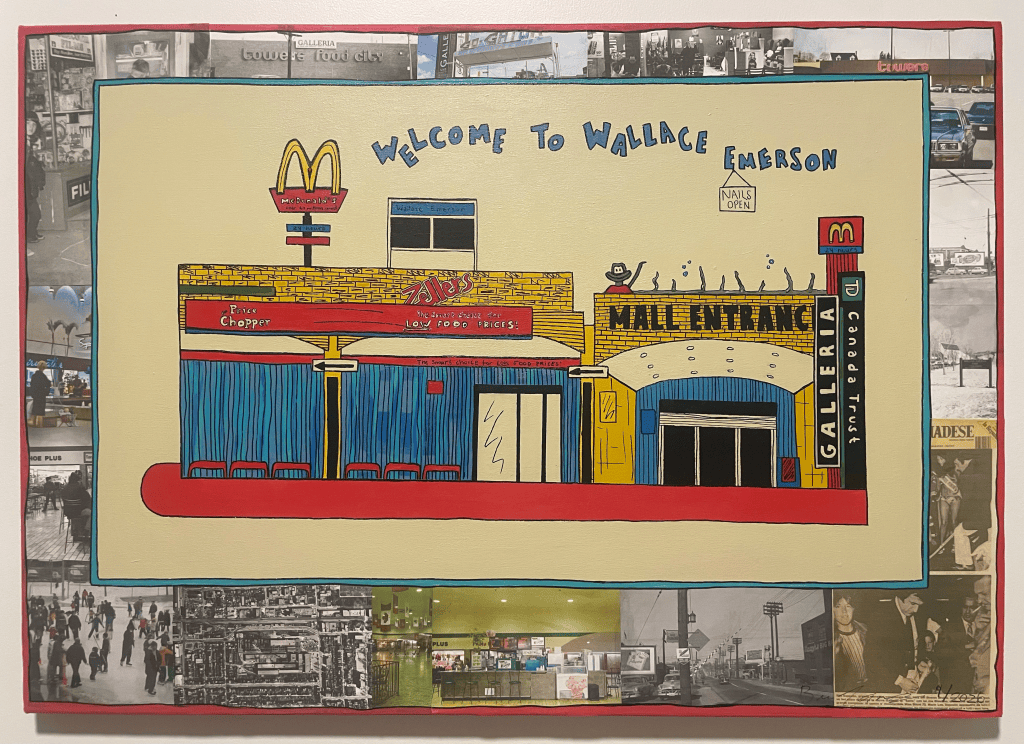
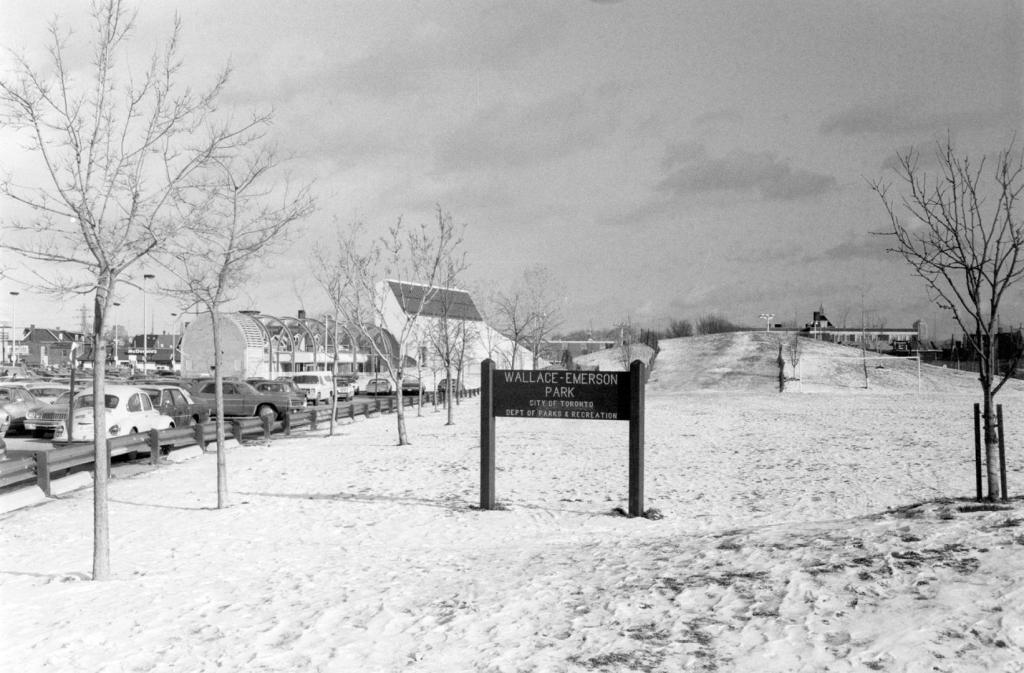
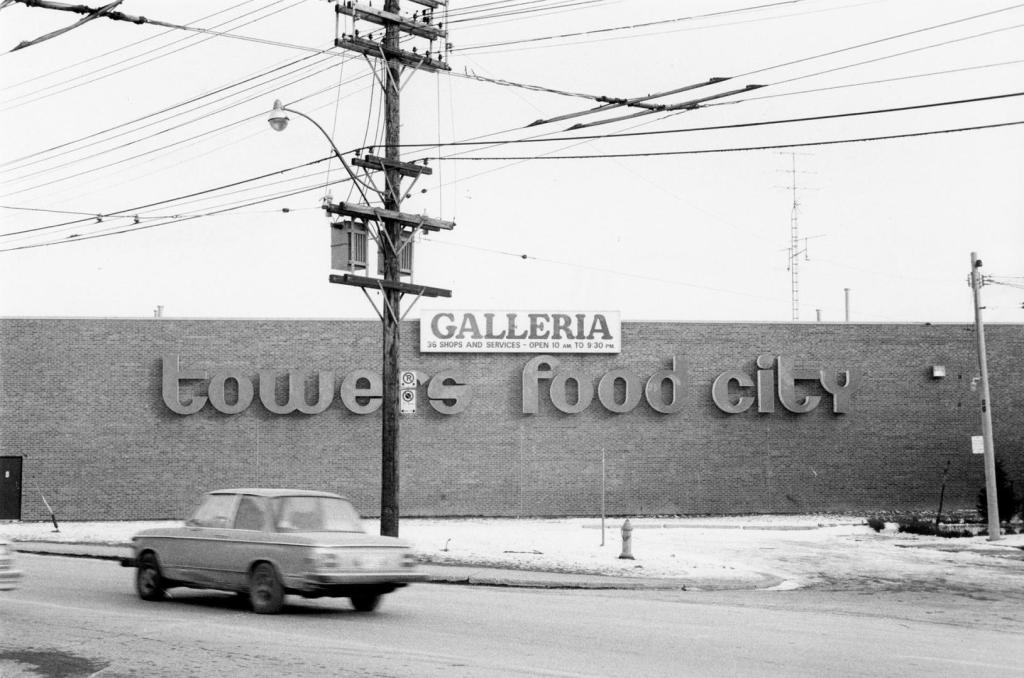
I learned how to swim at Wallace Emerson Community Centre. My mom enrolled us in dance, gymnastics, and all kinds of sports, and I spent summers here at camp. I remember running down the big hill in the park behind the centre so fast that my legs felt like they were going to fall off. On Saturdays, we would stop at Dollarama in Galleria Mall before our lessons so my mom could eat a snack while she waited. When we went grocery shopping, we went to Price Chopper, with my mom always pushing a cart while Neha sat inside. We always got the large Coke on McDonald’s Dollar Drink Days.
When I saw the condo being built at Dufferin and Dupont, I audibly gasped. Parts of Galleria Mall were closed in 2020 to make way for its construction. Now they’re demolishing the community centre and replacing it with a larger, modern one. I understand the need for updated spaces, but I don’t like this change. This change leaves a bad taste in my mouth.
I don’t need another Tim Hortons or a “wellness lifestyle” built around spin studios and luxury amenities. What happens to the shelters and supportive housing nearby when this neighbourhood becomes something designed for new residents? I worry that, in making the area “better,” we may lose the community that made it home.
HISTORY
Toronto’s community spaces trace back to the Settlement House Movement, which aimed to support immigrants and working-class families. The movement began in London with Toynbee Hall in 1883. In Toronto, an early precursor was the Young Women’s Settlement, established in 1899 and renamed Evangelia House in 1902.
Central Neighbourhood House, founded in 1911 by John Kelso and University of Toronto students, supported newly settled immigrants in the Ward. During its first week, more than 400 people used the facility. Its programs included citizenship lectures and children’s clubs, classes, and outings.
The Cecil Community Centre, built in 1890, was originally a Protestant Church, and later became a synagogue, a Chinese Catholic Centre, and later the headquarters of the Community Homophile Association of Toronto. Each community adapted the space to meet its needs. Since becoming a city-run community centre in the late 1970s, Cecil has continued this tradition by offering camps, educational programs, fitness and health classes, language programs, and tax clinics.
Today, community centres remain essential because they provide services and spaces that reflect the needs of the people who live around them. At Wallace Emerson, a diverse and largely working-class community has relied on the centre for recreation, education, childcare, and connection since its establishment in the early 80s. These centres are places where communities gather, grow, and support one another.
SOURCED MATERIAL
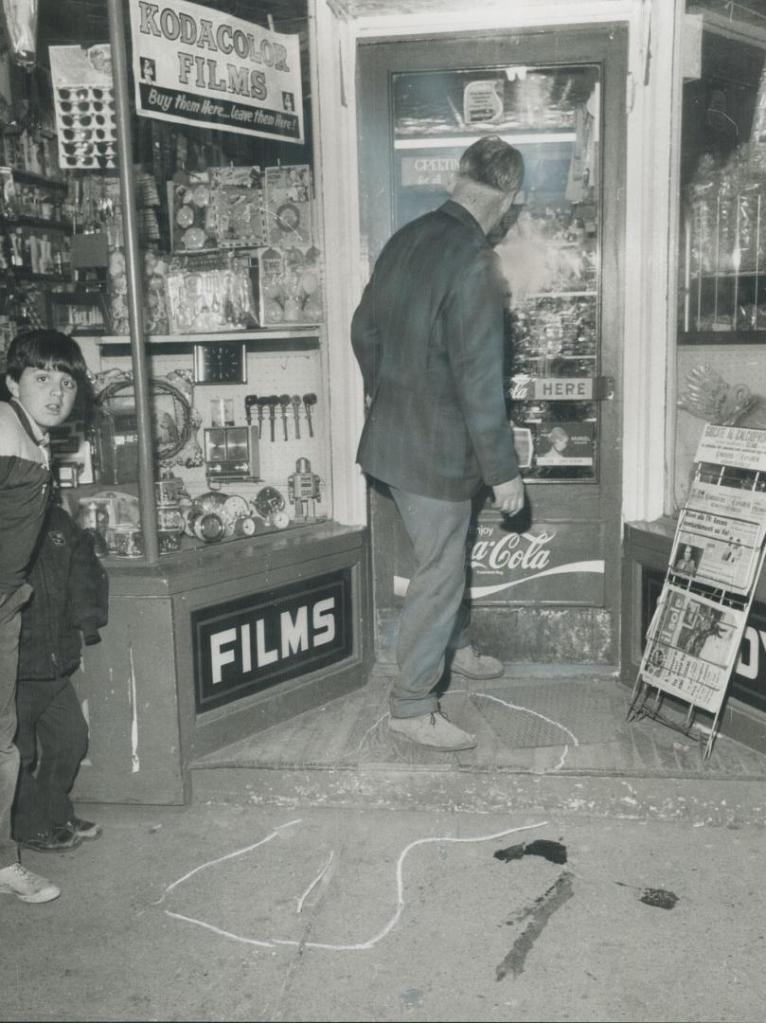
Outside a store in the Dufferin-Dupont area, 1972, Toronto Star Archives
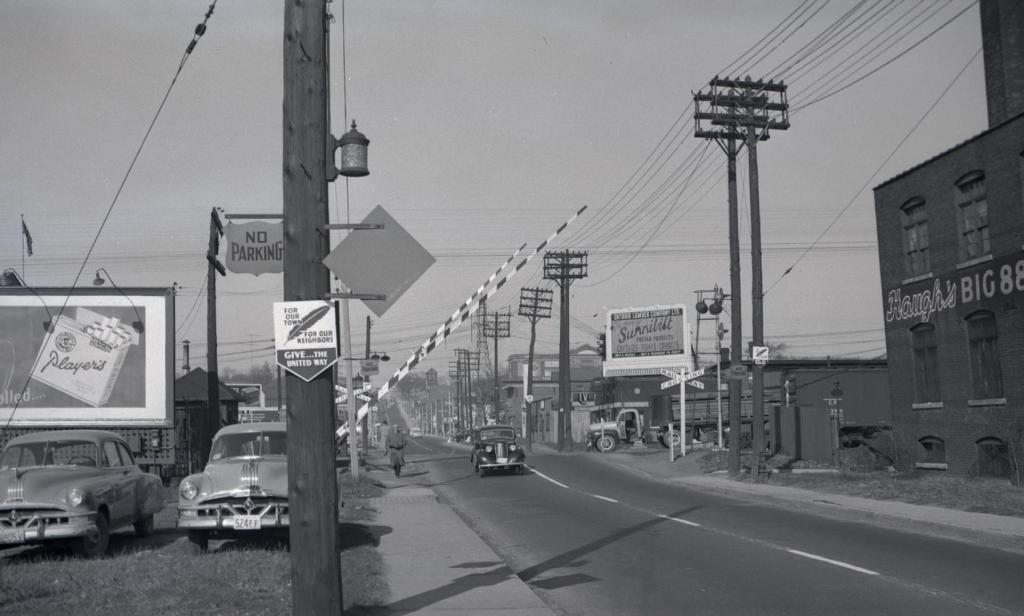
Dufferin Street showing C.P.R. level crossing, 1952, Baldwin Collection of Canadiana, PICTURES-R-4935
Signs for Tower’s and Food City stores, Galleria shopping centre, 1980, Local History Collection, LOCHIST-BL-088
Wallace-Emerson Park, 1980, Local History Collection, LOCHIST-BL-116
James, Cathy. “Reforming Reform: Toronto’s Settlement House Movement, 1900–20.” The Canadian Historical Review 82, no. 1 (2001): 55-90. https://muse.jhu.edu/article/591738.
“The History of Toronto’s Cecil Centre,” Museum of Toronto, 2024, https://museumoftoronto.com/digital-content/dyk_the-history-of-torontos-cecil-centre/
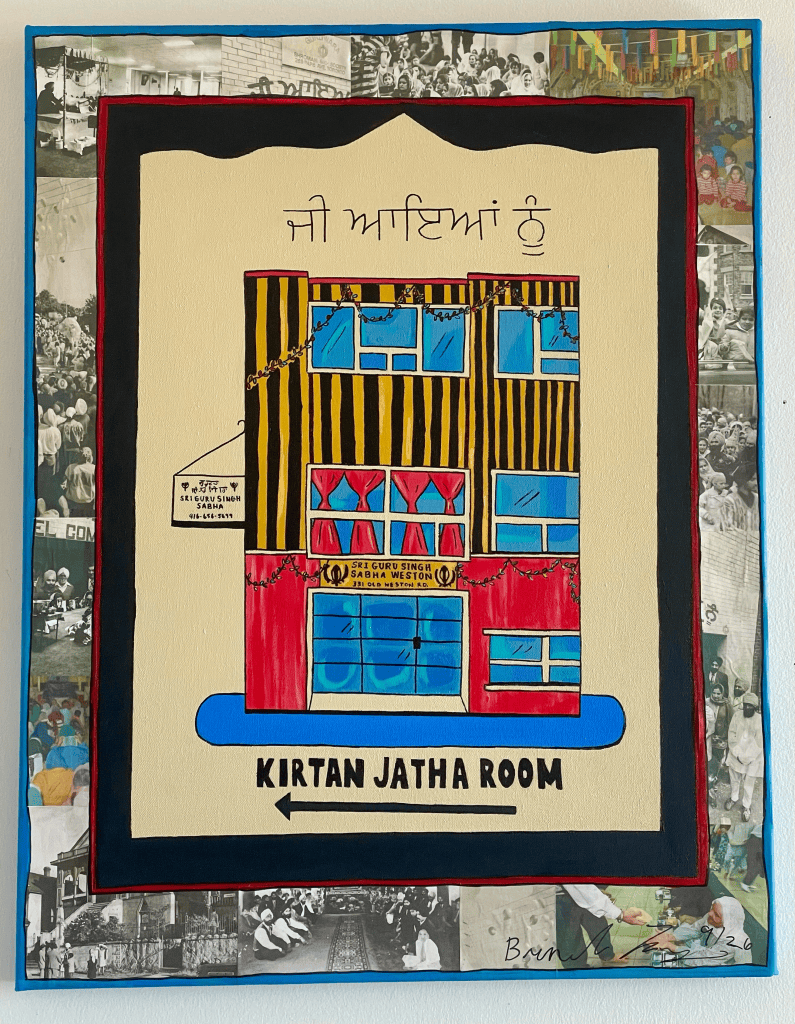
ਸਤਿ ਸ੍ਰੀ ਅਕਾਲ
(Sat Śri Akāll)
20 x 26″
Mixed Media on Canvas
September 2026
MEMORY
My family went to the gurdwara at 331 Old Weston Road. For context, we are not Sikh. My dad had made friends with a Sikh family who recommended it. He liked it there, and because it was close to our house, we started going too. I remember questioning why we went every New Year’s Eve and once a month. I liked it there too. I didn’t understand the language, religion, or customs, but somehow I still felt connected to the space.
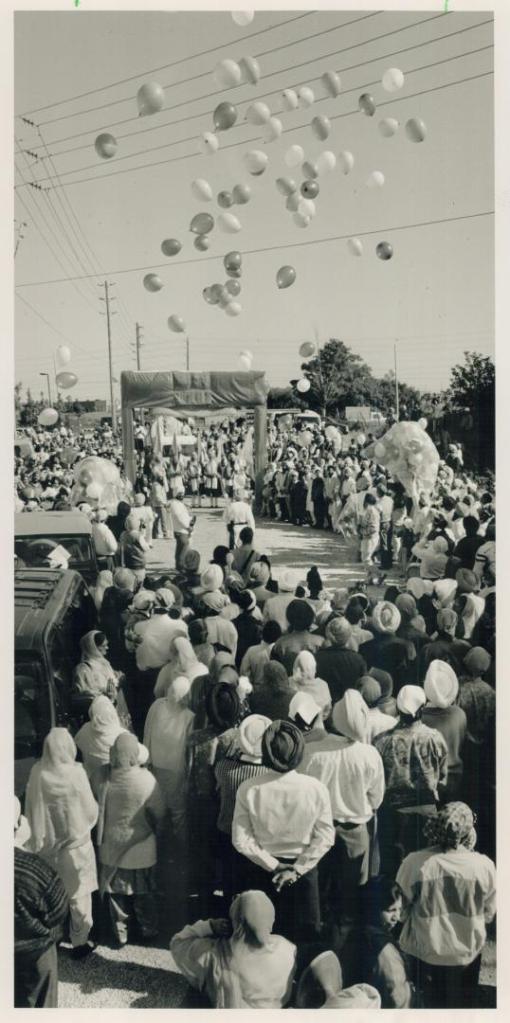
I especially remember walking from Exhibition Place to Nathan Phillips Square for the Vaisakhi Festival each spring. It was always cold and raining. We ate food early in the morning and walked while collecting cans of Coke and bags of halwa that they handed out under the Gardner Expressway Bridge.
That is what makes this city special. There are so many spaces where people can find belonging while being exposed to cultures and experiences different from their own. These communities helped build this city, didn’t they?
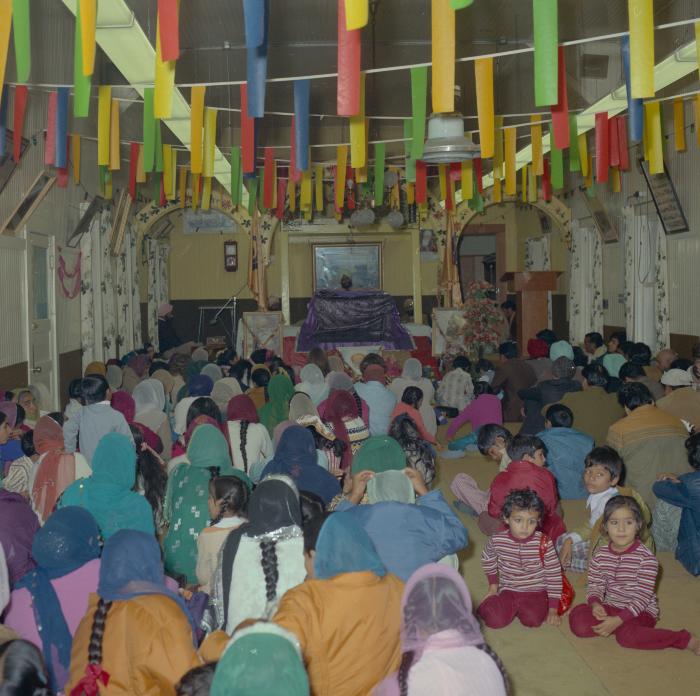
This gurdwara opened in 1975 and became a hub for Punjabi refugees in the 1980s. I sat cross-legged beside my parents in the same langar, copying their gestures and Punjabi phrases to ask for two rotis and kheer.
Will these spaces still exist for my children? Years from now, will they still be here for me to remember?
HISTORY
Toronto’s immigrant history is deeply connected to The Ward (St. John’s Ward). In this downtown neighbourhood, successive waves of newcomers arrived, lived, worked, and built a community from the 1840s through the mid-20th century.
Among the earliest residents were Black refugees who arrived through the Underground Railroad and Irish immigrants fleeing the Great Famine. The southern Ward developed as a working-class neighbourhood, shaped by taverns, small businesses, political activity, and diverse immigrant communities.
From the late 19th century into the early 20th century, Jewish, Italian, Chinese, and other immigrant communities transformed The Ward. In 1911, a City of Toronto Department of Health investigation documented severe conditions that contributed to the neighbourhood’s classification as a “slum.” Early Chinese residents established Toronto’s first Chinatown in The Ward, creating businesses, homes, and community networks. Demolition later displaced that community to make way for present-day Toronto City Hall and Nathan Phillips Square. Chinese residents and businesses later gradually established a new Chinatown around Spadina Avenue and Dundas Street.
Other immigrant communities experienced similar patterns of movement. Toronto’s early Greek community, concentrated around the Ward and downtown Yonge Street, represented one per cent of the city’s population but owned and operated 35 per cent of its shops and restaurants by 1914. The community was disrupted by the anti-Greek riots of 1918, where many families and business owners moved eastward across the Don Valley, contributing to the growth of what is now Greektown on Danforth Avenue.
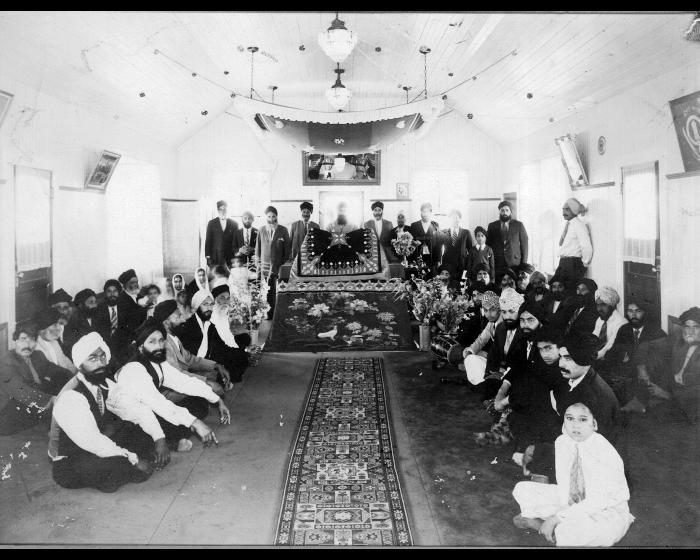
Later immigration reforms, including the introduction of the points system in the 1960s and official multiculturalism in the 1970s, brought new waves of immigrants from Asia, Africa, the Caribbean, and elsewhere. The first gurdwara in Ontario was established in 1969 at 269 Pape Avenue. The Shromani Sikh Sangat, or Pape Gurdwara, became an important hub for newly arrived South Asians to Ontario, with people travelling from Kitchener, Waterloo, and Kingston and beyond to connect with their community. Central to Sikhism is inclusivity, as people of all backgrounds and faiths are welcomed without judgment. Gurdwaras across Canada have continued this tradition by supporting newcomers and international students with meals, temporary shelter, and guidance as they settle into the country.
SOurced Material
Gur Sikh Temple in Abbotsford, 1912, South Asian Canadian Archives
Image of the wedding guests in Gurdwaram 1980, The Reach Gallery Museum, South Asian Canadian Archives
First Sikh Gurdwara in Canada, 1866 West 2nd Ave, Vancouver, 1948. Toronto Public Library Archives
Sikhism, 1973, Toronto Star Archives, TSPA_0013389F
Sikhs celebrate holy day, 1983, Toronto Star Archives, TSPA_0013378F
Sikhs celebrating at Queen’s Park, 1991, Toronto Star Archives, TSPA_0013396F
Baisakhi Day Community meal at Dixie Rd Sikh Temple, 1996, Toronto Star Archives, TSPA_0013400F
“Big Stories in Little India,” Heritage Toronto, 2024,
https://www.heritagetoronto.org/explore/big-stories-in-little-india-map-tour/shromani-sikh-sangat/
“Capturing Mid-Century Toronto: A Community of Immigrants,” Heritage Toronto, 2024,
https://www.heritagetoronto.org/explore/capturing-mid-century-toronto/community-of-immigrants/
Troper, Harold. “Becoming an Immigrant City: A History of Immigration into Toronto since the Second World War,” The World in a City, January 2003, DOI:10.3138/9781442670259-003
“Connected to the roots: Sikhism in Canada,” The X 1069, March 12, 2018,
https://www.1069thex.com/2018/03/12/connected-to-the-roots-sikhism-in-canada/
.
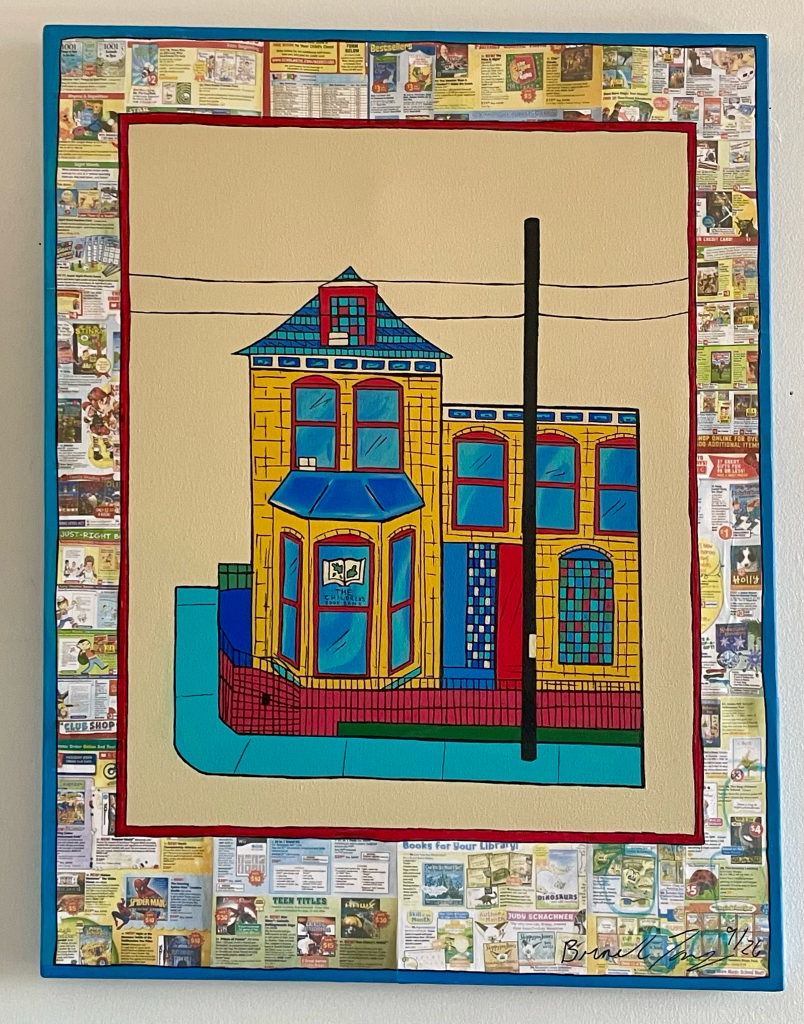

“When I Have Kids: They Will Be Allowed to Read”
20 x 26″
Mixed Media on Canvas
September 2026
MEMORY
There was a place called the Children’s Book Bank in a tiny house near the Parliament Library at 350 Berkeley Street. Every Thursday, I went to the library for French homework help, and afterwards we visited the Book Bank. You could only take one book per visit, so it took a while to collect all the Harry Potter books.
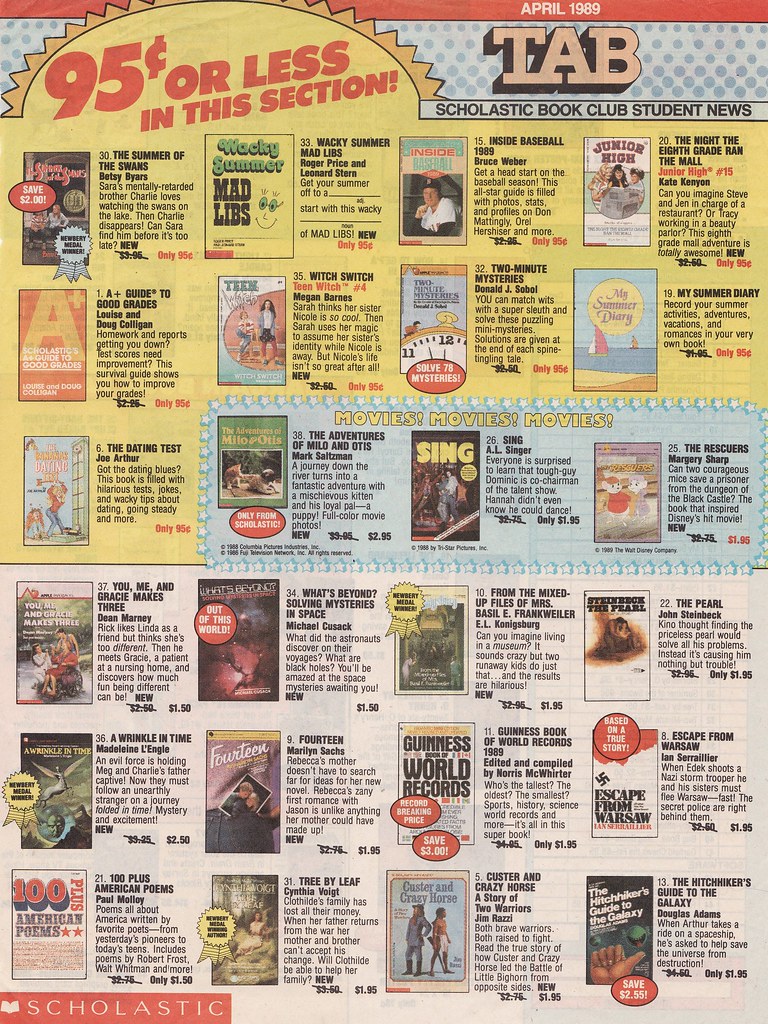
Everyone in my third- and fourth-grade classes was obsessed with Harry Potter. I desperately wanted to read the books like everyone else, but I couldn’t yet read. So I taught myself. The books were difficult for a child who couldn’t spell out the words, but one day I finally read the first Harry Potter book, and it was incredible. From then on, I loved reading.
I read the entire Series of Unfortunate Events in two days and Percy Jackson in a week. Neha and I read the entire YA section at the library beside our school one year.
But I wasn’t supposed to be reading. Pretty early on, I learned that if I wanted to read, I had to hide it. I read under the covers, stayed up late, read in the bathroom, and pretended they were school assignments.
Today, I make excuses for why I don’t read anymore. I say I don’t have time. But when I do, I remember that girl who loved books because they gave her an escape.
HISTORY
Toronto has a long history of creating programs that provide essential services and opportunities to families who may otherwise face barriers to accessing them. The area surrounding Regent Park and Cabbagetown has also been shaped by repeated cycles of redevelopment, displacement, and community-building.
Regent Park was developed in the late 1940s as one of Canada’s largest public housing communities. Its construction followed decades of concern about poor housing conditions in the surrounding neighbourhood, and later large demolitions of multiple blocks of existing homes and community restructuring. Over time, Regent Park developed a strong and diverse community despite its physical and social isolation from surrounding neighbourhoods.
Beginning in 2005, Regent Park underwent a major revitalisation intended to transform the neighbourhood into a mixed-income, mixed-use community. The redevelopment introduced new market housing, parks, streets, businesses, and community facilities alongside replacement social housing. While the plan committed to replacing demolished rent-geared-to-income units, redevelopment has also meant years of demolition, relocation, and disruption for existing residents. More recently, the City has acknowledged that some long-term residents have struggled to find appropriately sized replacement units within Regent Park, creating further displacement.
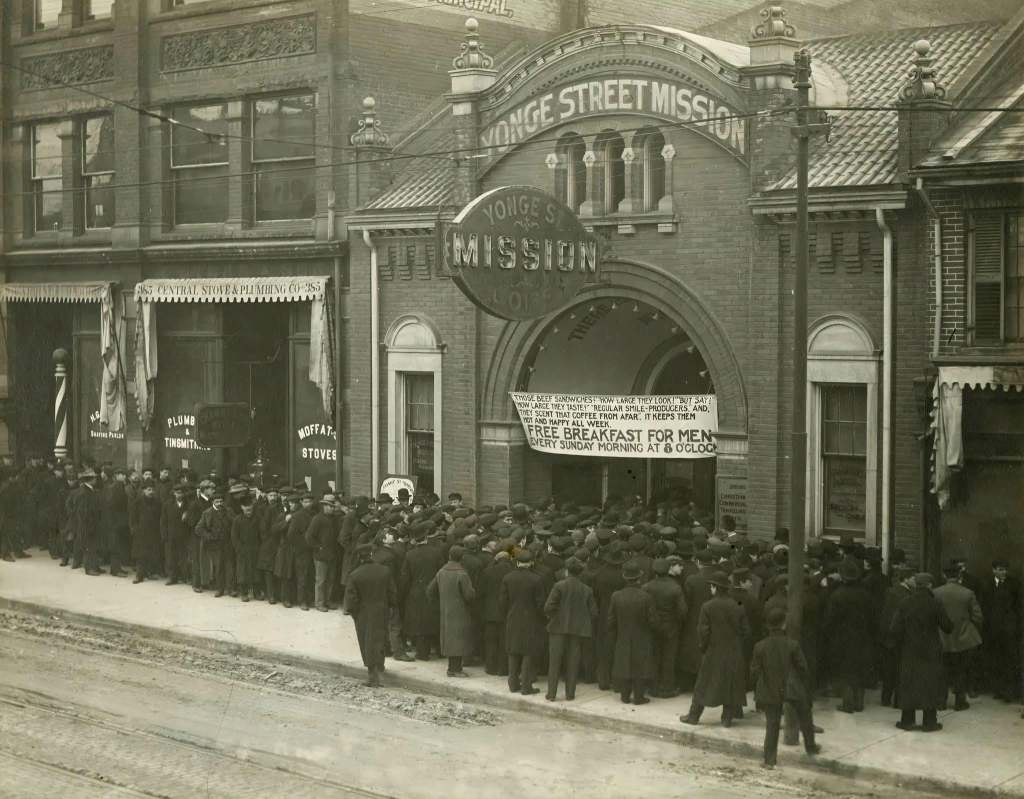
The Children’s Book Bank opened in 2008 at 350 Berkeley Street, providing free books and literacy support to children living in high-needs neighbourhoods, including Regent Park, St. James Town, and Jane and Finch. The Book Bank distributed books and literacy materials through community centres, schools, health clinics, and social agencies across the city. In 2022, the original location closed, and the Book Bank moved to 585 Dundas Street, placing a literacy-focused community resource directly within a neighbourhood experiencing significant change. That year, it distributed 120,000 donated books and offered free literacy-focused activities to thousands of children and families.
Sourced Material
Scholastic Book Catalog, 2009, Scholastic, Internet Archive, https://archive.org/details/scholastic-2009-december_202504
Scholastic Book Catalog, 2008, Scholastic, Internet Archive, https://archive.org/details/scholastic-2008-october
Scholastic Book Catalog, 2011, Scholastic, Internet Archive, https://archive.org/details/scholastic-2011-spring
“About,” Children’s Book Bank, 2024,
https://www.childrensbookbank.com/about
“Who we are,” Yonge Street Mission, 2026,
https://www.ysm.ca/who-we-are/

